

 en
 Español
 русский
 中文简体

TO-VC04 Elevator Operation Panel: Intelligent Control, Durable Design, and Manufacturing Excellence
Content
- 1 1. The Role of an Elevator Operation Panel in Modern Buildings
- 2 2. Product Overview of the TO-VC04
- 3 3. Design Advantages Compared with Basic or Uncoordinated Panels
- 4 4. Application Areas
- 5 5. Manufacturing Strength Behind the Product
- 6 6. Quality Management and Process Control
- 7 7. Environmental and Occupational Management
- 8 8. Advantages for International Elevator Projects
- 9 9. Selecting the Correct TO-VC04 Configuration
- 10 10. Maintenance and Long-Term Service Considerations
- 11 11. Why Choose a Complete Elevator Manufacturer?
- 12 12. A Manufacturing Partner for Diverse Building Requirements
- 13 13. Frequently Asked Questions
- 13.1 Q1: What is the TO-VC04?
- 13.2 Q2: Which types of elevators can use the TO-VC04?
- 13.3 Q3: Is the TO-VC04 suitable for a customized elevator project?
- 13.4 Q4: Why is compatibility with the elevator controller important?
- 13.5 Q5: Can the panel be used in hospitals?
- 13.6 Q6: Can the TO-VC04 be used in a villa elevator?
- 13.7 Q7: What manufacturing capabilities support the product?
- 13.8 Q8: Which management standards does the company report following?
- 13.9 Q9: Can the panel be coordinated with elevator cabin interiors?
- 13.10 Q10: Is the TO-VC04 suitable for replacement or modernization work?
- 13.11 Q11: What information should be supplied when requesting a quotation?
- 13.12 Q12: How should the panel be maintained?
- 13.13 Q13: What makes a complete elevator manufacturer advantageous?
- 13.14 Q14: Does the product include every function shown in a typical elevator panel?
- 13.15 Q15: How can overseas customers contact the supplier?
- 14 14. Recommended Project Workflow
- 15 15. Conclusion
- 16 References
- 17 Product: TO-VC04
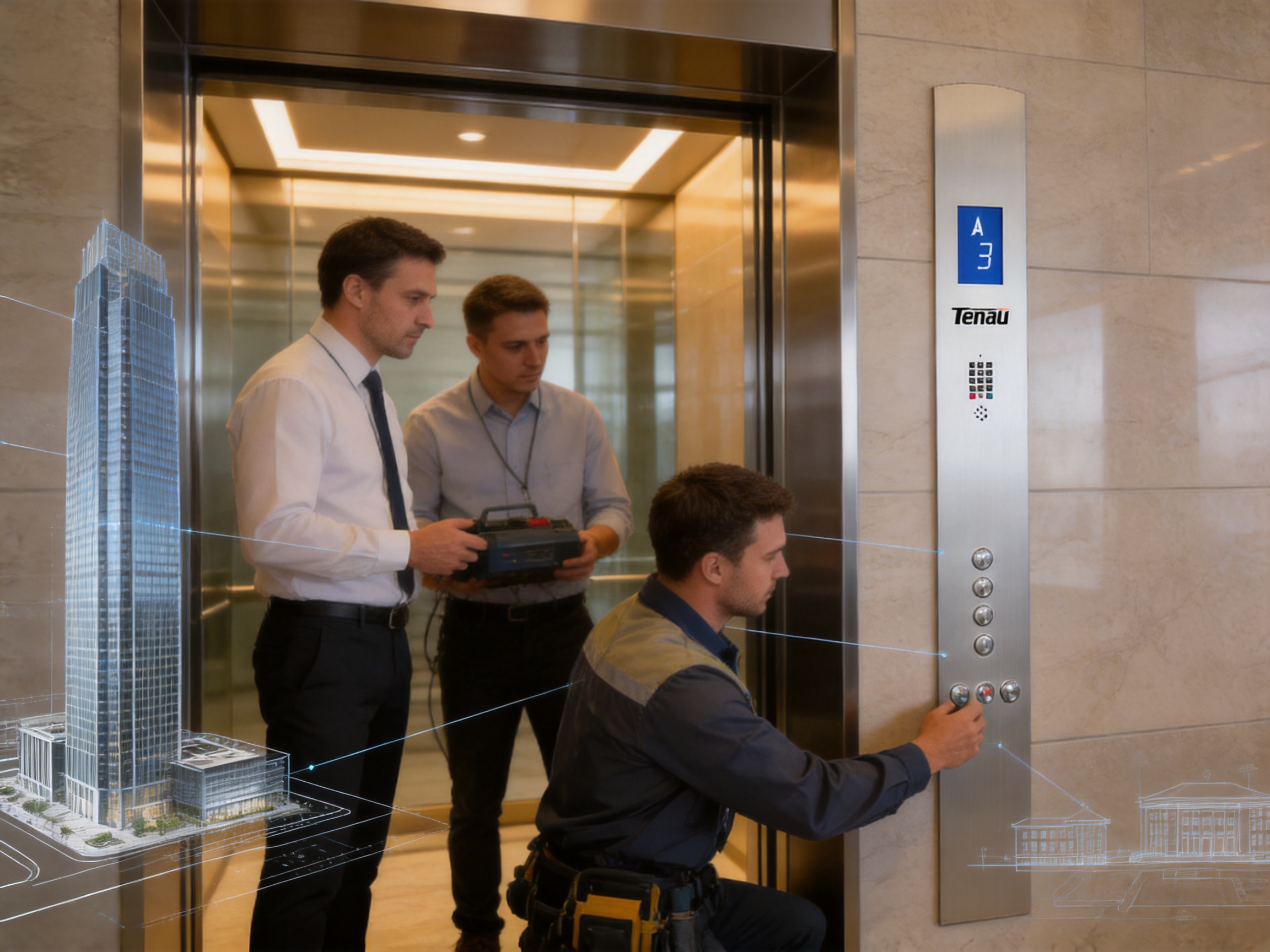
Elevator operation panels are among the most visible and frequently used components in a vertical transportation system. Every passenger interacts with the panel when selecting a floor, opening or closing doors, activating an alarm, or requesting assistance. In commercial buildings, hospitals, residences, hotels, transportation facilities, and industrial properties, the operation panel contributes directly to usability, accessibility, safety perception, and interior appearance.
The TO-VC04 elevator operation panel is designed for modern elevator applications that require dependable control, clear human-machine interaction, and coordinated interior styling. As part of a comprehensive elevator solution, it can be integrated into passenger elevators, panoramic and observation elevators, hospital elevators, home villa elevators, cargo elevators, car elevators, high-speed elevators, and other vertical transportation systems. Its role is not limited to providing buttons. A well-designed operation panel serves as the interface between passengers and the elevator control system, combining functional operation with visual communication and architectural design.
Manufactured by Tenau Elevator (China) Co., Ltd., the TO-VC04 reflects the company’s broader approach to elevator engineering: combining design, research and development, manufacturing, installation, and after-sales service within one coordinated organization. This integrated structure helps customers manage product selection, customization, project coordination, and long-term service more efficiently.
In a competitive elevator market, an operation panel must satisfy several requirements at the same time. It must be easy to understand, sufficiently robust for repeated daily use, compatible with the elevator system, suitable for the building’s interior, and manufactured under consistent quality controls. The TO-VC04 is positioned as a practical and adaptable solution for projects that need a professional appearance without sacrificing operational reliability.
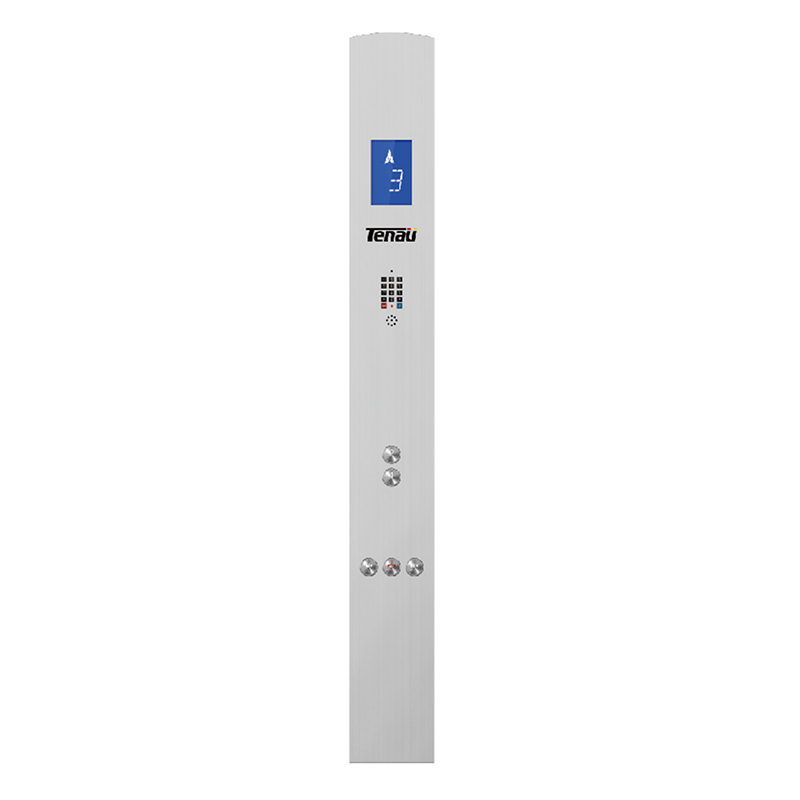
TO-VC04
1. The Role of an Elevator Operation Panel in Modern Buildings
An elevator operation panel is a critical human-machine interface. It allows passengers to communicate their travel requirements to the elevator system and receive visual or tactile feedback in return. Although the panel is usually compact, it supports a wide range of operational functions and must remain dependable throughout the service life of the elevator.
In a typical passenger elevator, the panel may include floor selection buttons, door open and door close controls, an alarm button, an emergency communication function, indicator lights, and other system-specific controls. Depending on the project, the panel may also support access control, destination dispatch, card readers, digital displays, voice prompts, fire service functions, or other intelligent elevator features.
For this reason, panel design affects more than appearance. The layout influences how quickly passengers understand the controls. The button arrangement affects operation efficiency. The surface material and manufacturing quality influence resistance to wear, fingerprints, cleaning agents, and accidental impact. The installation method affects maintenance access and long-term fit and finish.
The panel is also one of the most frequently touched elements in a building. In an office tower, it may receive thousands of interactions every day. In a hospital, it may be exposed to frequent cleaning and disinfection. In a cargo or car elevator, it may need to withstand a more demanding operating environment. In a villa elevator, the panel may be expected to coordinate with a carefully designed residential interior.
A suitable operation panel therefore needs to balance four important objectives:
1. Functional clarity, so passengers can operate the elevator easily.
2. Mechanical and surface durability, so the panel remains reliable and presentable over time.
3. Aesthetic adaptability, so it can coordinate with different cabin designs and architectural styles.
4. System compatibility, so it can be incorporated into the complete elevator control and safety architecture.
The TO-VC04 is developed around these practical requirements. Its value lies in combining the everyday convenience expected from a modern operation panel with the manufacturing capabilities of a professional elevator company.
2. Product Overview of the TO-VC04
The TO-VC04 is an elevator operation panel intended for use as part of a complete elevator cabin and control solution. Its core purpose is to provide passengers with an accessible and organized interface for elevator operation. It can be considered for new elevator installations, replacement projects, modernization programs, hospitality developments, residential buildings, public facilities, and commercial properties.
The product category is important because an elevator operation panel is not an isolated decorative accessory. It must be selected according to the elevator’s control system, cabin layout, operating requirements, regulatory conditions, and interior concept. The TO-VC04 can be discussed with the project supplier or engineering team to determine the appropriate configuration for a particular installation.
Because elevator projects vary significantly, final details such as button arrangement, display functions, materials, finishes, dimensions, markings, illumination, communication features, and mounting solutions may depend on the overall elevator specification. This makes technical confirmation an important part of the purchasing process. A professional supplier should review the application before production so that the panel is coordinated with the elevator controller, car operating system, landing fixtures, wiring, cabin structure, and local requirements.
The TO-VC04 is suitable for projects where the operation panel must offer a clean, professional appearance and dependable daily performance. It may be incorporated into different elevator cabin concepts, including functional commercial interiors, luxury residential cabins, durable freight environments, institutional facilities, and visually prominent panoramic elevators.
One of its principal strengths is adaptability. A panel used in a premium hotel may be evaluated primarily for its visual harmony and user experience. A panel used in a hospital may be evaluated for cleanability, intuitive operation, and compatibility with accessibility requirements. A panel used in a cargo elevator may be evaluated for ruggedness and ease of maintenance. A panel used in a villa may need to fit a highly customized interior. A flexible product platform allows the supplier to respond to these different priorities more effectively than a one-size-fits-all approach.
3. Design Advantages Compared with Basic or Uncoordinated Panels
3.1 Clearer interaction
A high-quality operation panel should communicate its functions immediately. Passengers should be able to identify floor buttons and service buttons without unnecessary confusion. Logical spacing, clear symbols, suitable illumination, and consistent labeling all contribute to a better user experience.
Compared with basic panels that may use inconsistent layouts or poorly coordinated components, a professionally engineered panel can make elevator operation more intuitive. This is especially important in public buildings, where users may speak different languages or may not be familiar with the facility. Visual clarity reduces hesitation and helps passengers complete their journey with fewer errors.
3.2 Better coordination with cabin interiors
The elevator panel occupies a prominent position inside the cabin. If its finish, shape, or proportions conflict with the surrounding walls and fixtures, the entire interior may appear less refined. A coordinated operation panel helps create a more complete design language.
For architectural projects, the panel can be considered together with handrails, ceiling lighting, wall cladding, flooring, door finishes, mirrors, displays, and other cabin elements. A professional elevator supplier can help customers determine an appropriate combination for the intended environment. This is an advantage over purchasing a generic panel from a separate source without confirming its integration with the complete elevator cabin.
3.3 Improved suitability for repeated operation
Elevator panels are subject to frequent pressing, contact with hands, cleaning, incidental impact, and temperature changes. A well-manufactured panel must maintain structural stability and a presentable surface after long-term use. The selection of appropriate materials, surface treatments, internal components, and assembly methods is essential.
Tenau’s elevator manufacturing background supports a more complete understanding of these requirements. Since the panel forms part of an entire elevator system, its design can be evaluated in relation to actual operating conditions instead of being treated only as a decorative product.
3.4 More efficient project coordination
When a customer purchases a panel from an elevator manufacturer that also provides complete elevator systems, coordination can be simpler. The supplier can review the relationship between the operation panel, controller, car operating system, elevator doors, safety functions, cabin structure, and installation process.
This integrated approach can reduce the risk of mismatched dimensions, incompatible wiring, incorrect button functions, or inconsistent visual design. It also provides a clearer channel for technical questions, production updates, installation guidance, and after-sales support.
3.5 Greater potential for customization
Different buildings have different operational and design requirements. A hospital may require special controls or accessibility-oriented arrangements. A high-end residential project may require a distinctive finish. A freight elevator may need a more impact-resistant configuration. A commercial tower may require access control or destination management integration.
The TO-VC04 can be evaluated as part of a project-specific configuration rather than selected only on the basis of a standard appearance. Customers should provide the supplier with information about the elevator type, building function, cabin dimensions, control system, desired finish, button requirements, display requirements, and applicable standards. This information allows the technical team to recommend an appropriate solution.
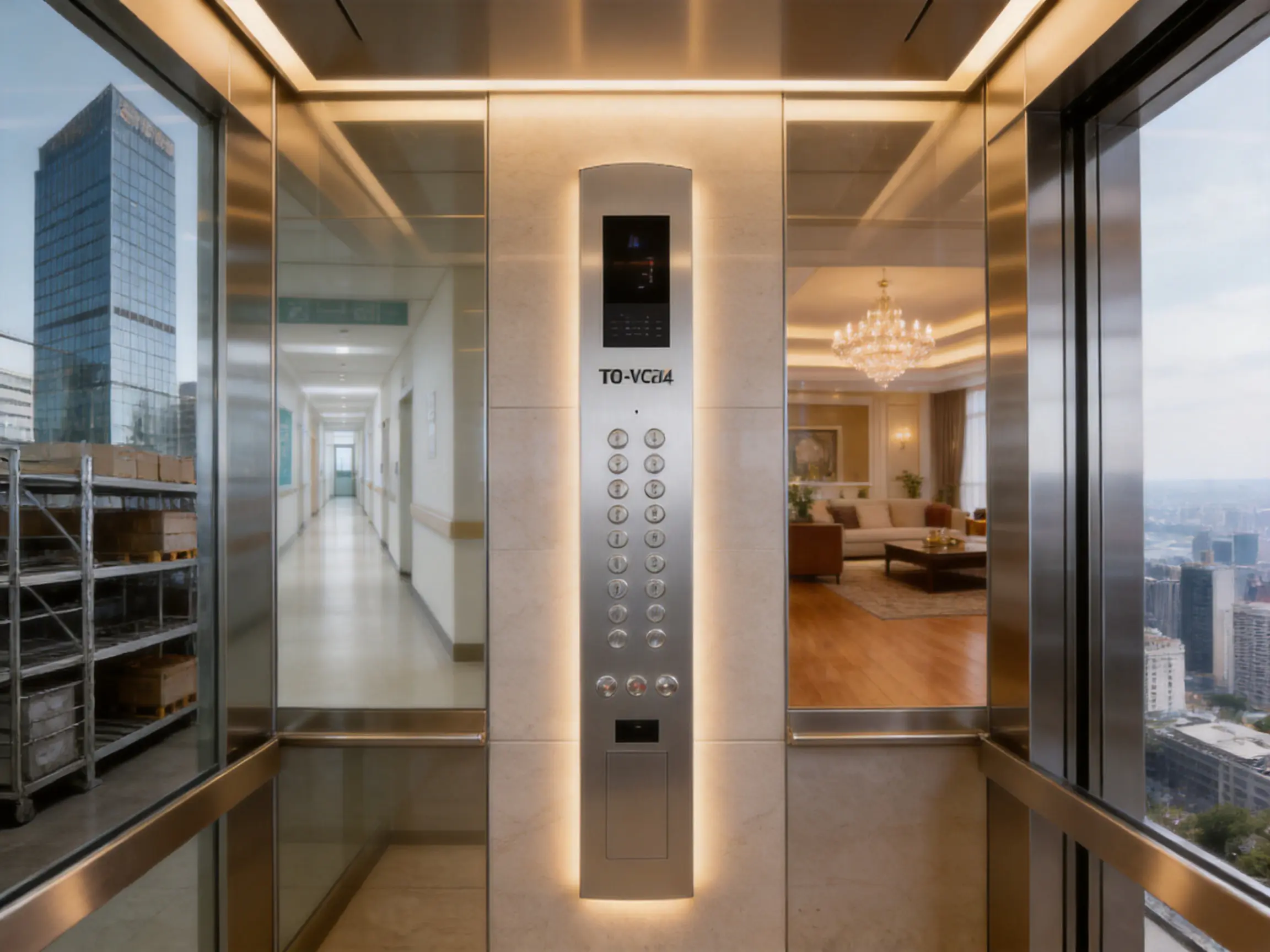
4. Application Areas
4.1 Passenger elevators
Passenger elevators require intuitive control and a comfortable user experience. The operation panel should be easy to identify, convenient to use, and visually consistent with the cabin. In offices, shopping centers, hotels, and apartment buildings, a reliable panel contributes to the perceived quality of the entire elevator.
The TO-VC04 can support passenger elevator projects that require a professional interface and coordinated interior design. Its use should be confirmed according to the elevator controller and the selected cabin configuration.
4.2 Panoramic and observation elevators
Panoramic and observation elevators are often architectural features rather than purely functional equipment. Passengers pay attention to the cabin’s appearance, lighting, materials, and details. The operation panel should complement the visual experience instead of becoming a distracting or poorly matched component.
For these applications, design coordination is particularly important. A panel must be positioned carefully and should work with the cabin’s transparent or highly visible surfaces. A well-integrated control panel supports the overall impression of precision and quality expected from observation elevators.
4.3 Hospital elevators
Hospital elevators operate in demanding environments. They may carry patients, medical personnel, visitors, beds, wheelchairs, carts, and equipment. The panel must therefore be considered in relation to accessibility, cleaning routines, traffic frequency, and the specific functions required by the hospital.
A hospital project may require special button heights, larger control areas, emergency communication features, priority operation, or other customized arrangements. The TO-VC04 should be configured according to the hospital’s operational plan and applicable regulations. Its value in this environment comes from being part of a customizable elevator solution supported by an experienced manufacturer.
4.4 Home and villa elevators
Residential and villa elevators often have lower traffic than public elevators, but their design expectations can be high. The operation panel may need to coordinate with wood, stone, glass, metal, decorative lighting, or other premium interior materials.
For private homes, users may also prefer simple controls, discreet styling, access control, and a compact arrangement. The TO-VC04 can be considered for residential projects where the panel must combine practical operation with a carefully coordinated cabin appearance.
4.5 Cargo elevators
Cargo elevators are designed for goods, equipment, pallets, carts, and industrial materials. Their operation panels may be exposed to more demanding use than those in a standard residential elevator. The panel selection should therefore consider protection, cleanability, impact risk, maintenance access, and the operating habits of warehouse or factory personnel.
A cargo elevator project may require a durable configuration with clear and straightforward controls. A professional manufacturer can help determine whether the selected panel arrangement and materials are appropriate for the expected environment.
4.6 Car elevators
Car elevators transport vehicles between parking levels and require clear operation for drivers, attendants, and facility personnel. The panel may need to function in a space where dirt, vibration, temperature variation, and repeated operation are common.
The TO-VC04 can be incorporated into a car elevator project after confirming the required control functions and environmental conditions. It can form part of a coordinated system that includes the car platform, doors, safety devices, control cabinet, signaling equipment, and access management.
4.7 High-speed elevators
High-speed elevators require carefully coordinated mechanical, electrical, and control systems. The operation panel is one visible part of a highly engineered installation. Its functions and communication with the control system should be verified as part of the complete high-speed elevator design.
Tenau’s capabilities in low-speed, medium-speed, high-speed, and ultra-high-speed elevator development provide a broad technical foundation for projects involving different performance levels. The panel should be selected in conjunction with the elevator’s control architecture, cabin design, safety system, and project specifications.
5. Manufacturing Strength Behind the Product
The quality of an elevator operation panel depends not only on its visible design but also on the systems used to develop, produce, inspect, and support it. Tenau Elevator (China) Co., Ltd. integrates design, research and development, manufacturing, marketing, installation, and after-sales service. This structure gives the company a broad perspective on product performance throughout the elevator life cycle.
A manufacturer that understands complete elevator systems can evaluate a panel according to real installation and service conditions. Engineering teams can consider how the panel interfaces with elevator wiring, controller signals, car operating functions, cabin structures, maintenance procedures, and passenger use. This system-level perspective is an advantage over suppliers that manufacture only isolated decorative components without responsibility for the complete elevator installation.
5.1 German-origin technical approach
Tenau originates from Germany and combines German technical concepts with manufacturing resources in China. The company describes safety and environmental protection as central parts of its mission. This approach supports a product development philosophy based on structured engineering, process discipline, reliability, and continuous improvement.
For a product such as the TO-VC04, a systematic engineering approach can influence many details: material selection, component compatibility, assembly accuracy, inspection methods, documentation, and service support. While the panel is a compact product, these background systems can significantly affect its consistency in actual projects.
5.2 Intelligent manufacturing
Tenau operates with German Industry 4.0 intelligent manufacturing concepts, automated production lines, big data, Internet of Things technology, and a closed-loop quality control system. These capabilities are relevant to elevator panels because repeatable production is essential for maintaining consistent dimensions, appearance, assembly quality, and functional performance.
Automated and digitally supported manufacturing can help reduce variation between production batches. Process data can provide greater visibility into manufacturing conditions and quality checkpoints. IoT-supported equipment can contribute to equipment monitoring, production management, and traceability. A closed-loop system can help identify issues, analyze causes, and support corrective actions.
These advantages become especially important for projects requiring multiple elevators or large quantities of identical components. Consistency across panels helps maintain a uniform visual appearance throughout a building and can simplify installation and maintenance.
5.3 Research and development capabilities
Elevator technology continues to evolve. Buildings increasingly request energy efficiency, intelligent control, access management, destination dispatch, remote monitoring, improved accessibility, and more personalized cabin design. An operation panel must evolve with these requirements.
Tenau’s research and development capabilities cover different elevator speed categories and a broad range of elevator products. This technical environment supports the development of associated components and interfaces. It also enables the company to assess the panel within the context of different elevator applications instead of limiting development to a single product type.
5.4 Large-scale manufacturing base
A large manufacturing base can provide advantages in production organization, equipment investment, workforce specialization, testing resources, and supply chain management. For international customers, manufacturing capacity is also important because it affects delivery planning and the supplier’s ability to support multiple projects.
Tenau’s location in Nanxun, Zhejiang Province, places the company within the Shanghai-Nanjing-Suzhou-Hangzhou economic circle. This region has strong manufacturing, logistics, engineering, and industrial supply chain resources. The company’s location can support coordination with domestic and international project requirements.
5.5 Intellectual property and technical accumulation
Tenau has a professional technical team and numerous intellectual property rights. Intellectual property activity indicates continuing investment in product development, engineering methods, and technical solutions. For customers, this can be valuable because it suggests that the manufacturer is building its own capabilities rather than relying solely on standard external products.
Technical accumulation also supports customization. When a project requires a different interface, special configuration, or coordinated design, an experienced engineering team is more likely to identify a practical path from concept to production.
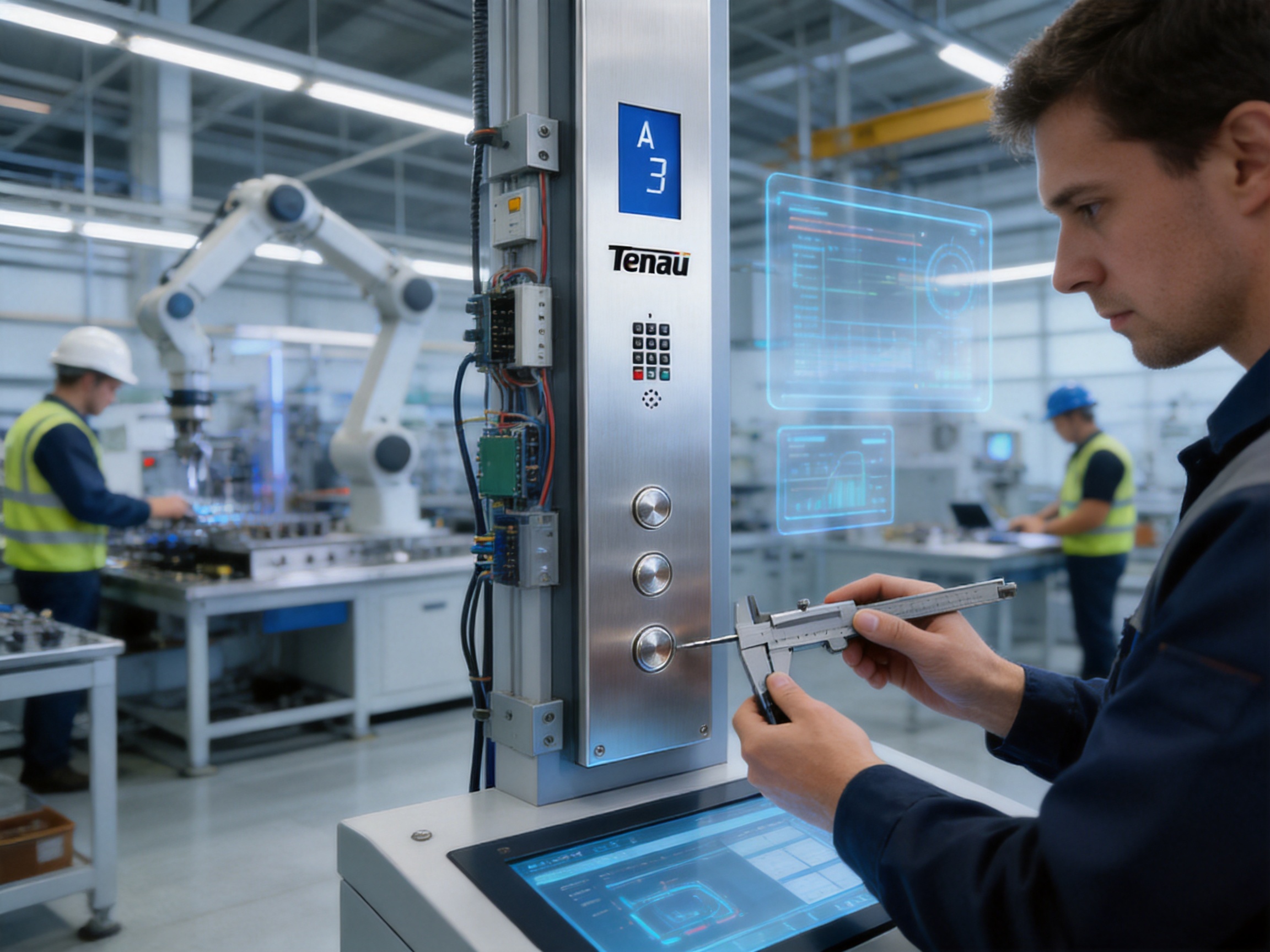
6. Quality Management and Process Control
Quality in elevator manufacturing must be managed throughout the entire process. Final inspection alone is not enough to guarantee reliable results. Effective quality management begins with design review and continues through purchasing, production, assembly, testing, packaging, installation, commissioning, and after-sales service.
Tenau reports compliance with ISO9001, ISO14001, and OHSMS18001 management standards. These standards relate respectively to quality management, environmental management, and occupational health and safety management. Together, they reflect an organizational approach that considers product quality, environmental responsibility, and safe working practices.
6.1 Design-stage control
At the design stage, the operation panel should be reviewed for function, dimensions, material suitability, installation method, wiring, maintenance access, and compatibility with the selected elevator system. Early design control helps prevent problems from appearing later during production or installation.
For a project-specific TO-VC04 configuration, the technical team may need to confirm the number and type of buttons, indicator arrangements, display requirements, communication functions, mounting dimensions, cabin wall structure, and finish expectations. Clear technical documents are important because they reduce misunderstandings between the customer, manufacturer, installer, and interior contractor.
6.2 Material and component control
Material and component quality influence both appearance and service life. The panel may include a visible faceplate, buttons, indicators, electrical components, wiring, fasteners, mounting elements, and protective parts. Each component should be suitable for its intended function and operating environment.
Material selection should also consider cleaning procedures, contact frequency, temperature, humidity, possible impact, and the design life of the elevator. In special environments such as hospitals, coastal buildings, industrial facilities, or transportation hubs, additional requirements may apply.
6.3 Production and assembly control
Accurate assembly is essential for a panel that must fit into a cabin wall and align with other fixtures. Inconsistent spacing, loose components, uneven surfaces, or incorrect wiring can affect both appearance and performance. Standardized work instructions, trained personnel, appropriate tools, and inspection checkpoints help maintain manufacturing consistency.
Digital production systems and automated equipment can support repeatability. However, skilled technical personnel remain important for interpreting specifications, handling customized orders, reviewing unusual conditions, and resolving production issues.
6.4 Testing and inspection
Testing requirements depend on the final configuration and the elevator system into which the panel is installed. Functional checks may include button response, indicator operation, communication with the control system, emergency functions, illumination, wiring continuity, and installation fit.
Inspection may also address visible finish quality, labeling, component positioning, fastener security, and packaging protection. When the panel is part of a complete elevator project, integrated testing during commissioning is necessary to confirm that the panel performs correctly with the controller, doors, displays, safety circuits, and other equipment.
6.5 Closed-loop improvement
A closed-loop quality system does not stop when a product leaves the factory. Information from installation teams, service personnel, customers, and field performance can be used to identify recurring issues and improve future designs or processes. This approach supports continuous improvement and helps the manufacturer respond to changing project expectations.
For international elevator projects, feedback is especially valuable because operating environments, installation practices, codes, user behavior, and maintenance conditions can vary by market. A manufacturer with a structured feedback process can build stronger product knowledge over time.
7. Environmental and Occupational Management
Modern elevator manufacturing must address environmental responsibility as well as product performance. ISO14001-oriented environmental management encourages organizations to identify and control environmental impacts associated with manufacturing operations, resource use, waste, emissions, and process management.
For an operation panel, environmental considerations may include material utilization, packaging, surface treatment, energy consumption during production, recyclability, and the responsible handling of manufacturing waste. While the panel itself is relatively compact, its production forms part of a larger industrial system.
Occupational health and safety management is also essential. Manufacturing, assembly, testing, warehousing, installation, and maintenance all involve potential workplace risks. OHSMS18001-related practices support safer working procedures, employee training, hazard identification, and continuous improvement in workplace protection.
These management systems benefit customers indirectly by supporting more stable operations and a more responsible supply chain. They also reflect the expectation that elevator manufacturers should consider the complete impact of their activities, not only the performance of the final product.
8. Advantages for International Elevator Projects
International customers often need more than a product. They require technical communication, project coordination, production reliability, export experience, documentation, installation support, and after-sales service. Tenau exports elevator products to many countries and regions worldwide, giving the company experience with international business requirements.
8.1 One supplier for multiple elevator categories
A customer developing a mixed-use project may need passenger elevators, service elevators, freight elevators, escalators, moving walks, or specialized systems. Working with a manufacturer that offers several categories can simplify procurement and coordination.
The TO-VC04 can be selected as part of a broader package that includes elevator equipment, cabin interiors, operation panels, landing panels, escalators, moving walks, and related components. A unified supplier may help maintain consistent technical documentation and visual standards across the project.
8.2 Technical communication
Technical communication is critical when a panel is customized or integrated into an imported elevator system. Questions about dimensions, wiring, functions, materials, finishes, and installation must be answered clearly and promptly.
A professional supplier should be able to provide project discussions, technical confirmation, product documentation, production updates, and installation guidance. Customers should prepare detailed project information so the manufacturer can provide an accurate recommendation.
8.3 Installation and after-sales support
The performance of an elevator panel depends partly on correct installation. Even a well-manufactured panel can experience problems if it is mounted incorrectly, connected to the wrong circuit, exposed to unsuitable conditions, or damaged during construction.
Tenau integrates installation and after-sales service into its business model. This integrated capability can support customers during commissioning, troubleshooting, maintenance planning, and future replacement requirements. The exact scope of support should be confirmed in the commercial and technical agreement for each project.
9. Selecting the Correct TO-VC04 Configuration
Because elevator projects vary, customers should not select an operation panel solely from a product image. A proper technical review helps ensure that the panel is suitable for the intended application.
| Selection factor | Information to confirm | Why it matters |
|---|---|---|
| Elevator application | Passenger, hospital, residential, cargo, car, panoramic, high-speed, or other use | Different environments require different levels of durability, accessibility, and functionality. |
| Control system | Controller type, communication method, and operating functions | The panel must communicate correctly with the elevator system. |
| Cabin dimensions | Wall structure, available mounting area, and panel location | Correct dimensions are necessary for accurate installation and interior coordination. |
| Button arrangement | Number of floors, service buttons, alarm functions, and special controls | The arrangement must match the elevator’s operational requirements. |
| Display and indicators | Floor display, direction indicators, illumination, voice prompts, or other interfaces | Clear feedback improves passenger understanding and accessibility. |
| Materials and finish | Surface appearance, cleaning requirements, corrosion exposure, and interior concept | Material selection affects durability, maintenance, and visual harmony. |
| Regulatory requirements | Local elevator codes, accessibility provisions, emergency functions, and project standards | Compliance must be assessed for the installation location. |
| Quantity and schedule | Number of units, production deadline, packaging, and delivery destination | Accurate planning helps maintain project schedule and consistency. |
Customers should also clarify whether the panel is required for a new elevator, a modernization project, or a replacement installation. Modernization work may involve existing cabin structures, legacy wiring, limited mounting space, or compatibility restrictions. These conditions should be reviewed before the order is finalized.
10. Maintenance and Long-Term Service Considerations
Regular maintenance helps preserve the operational and visual condition of an elevator operation panel. Maintenance personnel should follow the elevator manufacturer’s instructions and applicable local regulations. Routine inspection may include checking button response, indicator operation, alarm and communication functions, mounting security, visible damage, surface condition, and wiring connections.
Cleaning procedures should be appropriate for the selected panel material and finish. Excessive moisture, abrasive tools, aggressive chemicals, or improper disinfectants may damage surfaces or internal components. In hospitals and other sensitive environments, the cleaning method should be reviewed with the elevator supplier and facility management team.
If a button, indicator, display, or communication function fails, the issue should be diagnosed by qualified personnel. Maintenance workers should not bypass safety functions or make unauthorized changes to the elevator control system. Replacement components should be verified for compatibility with the original configuration.
Good documentation supports long-term service. Project records should include the panel model, configuration, wiring information, spare parts, installation instructions, inspection records, and relevant technical approvals. This information can reduce downtime and simplify future maintenance or modernization.
Tenau’s integrated after-sales approach provides a foundation for ongoing support. Customers can discuss service requirements, replacement parts, troubleshooting procedures, and maintenance arrangements as part of the project planning process.
11. Why Choose a Complete Elevator Manufacturer?
Buying an operation panel from a complete elevator manufacturer can offer several advantages. First, the supplier understands the panel’s role within the entire elevator. Second, the panel can be coordinated with the controller, cabin, landing fixtures, safety system, and installation process. Third, the customer has a more direct channel for technical support and after-sales service.
Independent component suppliers can be useful in certain situations, particularly for standardized replacement parts. However, project applications often require more extensive coordination. A panel may appear compatible based on its dimensions while still having differences in wiring, communication, button logic, illumination, or emergency functions.
Tenau’s product range includes passenger elevators, freight elevators, escalators, moving walks, high-speed elevators, cabin interiors, and related elevator solutions. This broad portfolio allows the company to approach the TO-VC04 as part of a complete mobility system rather than as an isolated panel.
For developers, contractors, architects, elevator distributors, and building owners, this can simplify decision-making. Instead of coordinating several unrelated suppliers, the project team can discuss equipment, interior design, operation panels, installation, and service with a manufacturer that has experience across multiple elevator categories.
12. A Manufacturing Partner for Diverse Building Requirements
Building design is becoming more varied. Urban residential towers require high-capacity passenger transportation. Hospitals require carefully planned movement of people, beds, and equipment. Shopping centers need convenient and attractive circulation. Warehouses require efficient freight movement. Villa projects seek personalized interiors. Airports, stations, and public facilities demand durability, accessibility, and high operating availability.
Each building type creates different expectations for elevator operation panels. A professional supplier must be able to understand these differences and provide recommendations that consider function, design, safety, maintenance, and project economics.
Tenau’s broad manufacturing capabilities and product categories support this diversity. The company’s experience with low-speed, medium-speed, high-speed, and ultra-high-speed elevators provides a technical base for different transportation requirements. Its use of intelligent manufacturing and quality management systems supports repeatable production. Its international business experience supports overseas project coordination.
The TO-VC04 is therefore best understood as one component within a broader engineering and manufacturing platform. Its competitive value is not based only on its visible appearance. It also comes from the organization behind it: research and development resources, production equipment, quality systems, technical personnel, project coordination, and service capability.
13. Frequently Asked Questions
Q1: What is the TO-VC04?
The TO-VC04 is an elevator operation panel used as the passenger interface for selecting floors and operating related elevator functions. It is intended to be integrated into a complete elevator system and cabin interior.
Q2: Which types of elevators can use the TO-VC04?
It can be considered for passenger elevators, panoramic and observation elevators, hospital elevators, home and villa elevators, cargo elevators, car elevators, high-speed elevators, and other suitable applications. Final compatibility depends on the elevator control system, cabin design, functions, dimensions, and project requirements.
Q3: Is the TO-VC04 suitable for a customized elevator project?
It can be evaluated for customized projects. Customers should provide information about the elevator type, number of floors, cabin dimensions, button arrangement, required functions, materials, finish, display, communication features, and applicable regulations. The manufacturer can then confirm the appropriate configuration.
Q4: Why is compatibility with the elevator controller important?
The operation panel sends commands and receives feedback from the elevator control system. If the communication method, wiring, button logic, or electrical characteristics do not match, the panel may not function correctly. Technical confirmation is therefore necessary before production.
Q5: Can the panel be used in hospitals?
It may be suitable for hospital elevator applications when configured according to the hospital’s operational and regulatory requirements. Hospital projects should consider accessibility, cleaning, disinfection, traffic frequency, emergency functions, bed and wheelchair movement, and any special control requirements.
Q6: Can the TO-VC04 be used in a villa elevator?
Yes, it can be considered for home and villa elevator projects where the panel must coordinate with a residential interior. The final appearance, dimensions, functions, and finish should be confirmed with the manufacturer according to the cabin design.
Q7: What manufacturing capabilities support the product?
Tenau integrates design, research and development, manufacturing, marketing, installation, and after-sales service. The company also uses intelligent manufacturing concepts, automated production lines, big data, IoT technology, and closed-loop quality control systems.
Q8: Which management standards does the company report following?
Tenau reports compliance with ISO9001 quality management, ISO14001 environmental management, and OHSMS18001 occupational health and safety management standards.
Q9: Can the panel be coordinated with elevator cabin interiors?
Yes. The operation panel should be selected together with the cabin wall materials, handrails, lighting, displays, flooring, doors, and other fixtures. Coordinated selection helps create a consistent visual appearance and supports correct installation.
Q10: Is the TO-VC04 suitable for replacement or modernization work?
It may be suitable, but modernization projects require careful evaluation of existing dimensions, mounting arrangements, wiring, controller compatibility, cabin construction, and regulatory requirements. The supplier should review the existing equipment before confirming the replacement configuration.
Q11: What information should be supplied when requesting a quotation?
Customers should provide the elevator type, quantity, number of floors, cabin dimensions, desired panel location, control system information, required buttons and displays, interior materials, finish requirements, destination country, applicable standards, delivery schedule, and installation or service expectations.
Q12: How should the panel be maintained?
Maintenance should be performed by qualified personnel according to the elevator manufacturer’s instructions. Regular checks should cover button operation, indicators, communication functions, mounting security, surface condition, and wiring. Cleaning products should be compatible with the selected materials and finish.
Q13: What makes a complete elevator manufacturer advantageous?
A complete elevator manufacturer can coordinate the panel with the controller, cabin, doors, safety system, installation process, and after-sales service. This may reduce compatibility risks and provide customers with a more direct technical support channel.
Q14: Does the product include every function shown in a typical elevator panel?
Not necessarily. Elevator operation panel functions vary by project. Floor buttons, alarm controls, door controls, displays, access control, voice prompts, and other features depend on the specified elevator system. The final configuration should be confirmed before ordering.
Q15: How can overseas customers contact the supplier?
International customers can contact Tenau Elevator (China) Co., Ltd. through its export sales channel to discuss product configuration, technical requirements, quotations, project schedules, installation, and after-sales service.
14. Recommended Project Workflow
A structured workflow helps customers obtain the correct operation panel and avoid later changes. The first step is to define the elevator application. The project team should identify whether the elevator is intended for passengers, hospitals, residences, freight, vehicles, observation use, or high-speed transportation.
The second step is to establish the technical requirements. These may include the number of floors, elevator speed, load capacity, cabin size, control system, door arrangement, button functions, emergency communication, displays, access control, and accessibility provisions.
The third step is to coordinate the interior design. Architects, interior designers, elevator engineers, and the manufacturer should review the panel location, visible dimensions, materials, finish, lighting, handrails, wall cladding, and maintenance access.
The fourth step is to confirm compliance. Local building codes, elevator standards, accessibility rules, fire service requirements, electrical requirements, and project specifications should be reviewed by the responsible technical parties.
The fifth step is to approve drawings and samples where necessary. For large or high-profile projects, a sample panel or finish sample can help the customer evaluate appearance, ergonomics, labeling, and coordination with the cabin.
The sixth step is production and inspection. Manufacturing should follow the approved technical documents. Inspection records, packaging protection, quantity checks, and delivery documentation help support a smooth installation.
The final step is installation, commissioning, and service planning. The operation panel should be tested as part of the complete elevator. Maintenance personnel should receive appropriate documentation and guidance for future operation.
15. Conclusion
The TO-VC04 elevator operation panel represents an important interface between passengers and the elevator system. Its responsibilities include more than floor selection. It contributes to safety perception, operational clarity, accessibility, cabin appearance, maintenance efficiency, and the overall quality of the building experience.
Its competitive advantages are strengthened by the capabilities of Tenau Elevator (China) Co., Ltd. The company combines German-origin technical concepts with a large-scale manufacturing base in Zhejiang, integrated elevator research and development, intelligent manufacturing, automated production lines, big data, IoT technology, closed-loop quality control, international standards-based management systems, and complete project services.
For customers, this means the TO-VC04 can be considered as part of a coordinated elevator solution rather than as an unrelated accessory. It can be evaluated for passenger elevators, panoramic elevators, hospital elevators, villa elevators, cargo elevators, car elevators, high-speed elevators, and other applications where reliable operation and professional design are required.
The best results will come from early technical communication. By confirming the elevator type, controller, cabin dimensions, functions, materials, finish, local standards, production schedule, and service expectations, customers can obtain a configuration that is better suited to their project. With the support of a complete elevator manufacturer, the operation panel can contribute to a safer, more attractive, more intuitive, and more maintainable vertical transportation system.
References
1. Product information for the TO-VC04 elevator operation panel, supplied for technical and marketing reference.
2. Corporate information of Tenau Elevator (China) Co., Ltd., including product categories, manufacturing capabilities, research and development activities, and service scope.
3. ISO 9001, Quality Management Systems—Requirements.
4. ISO 14001, Environmental Management Systems—Requirements with Guidance for Use.
5. OHSMS 18001 occupational health and safety management system principles.
6. General engineering principles for elevator operation panels, human-machine interfaces, accessibility, maintenance, and elevator cabin integration.
7. General Industry 4.0 manufacturing principles, including automation, production data management, traceability, and closed-loop quality improvement.
Product: TO-VC04

Related Products
Related News
Built on safety, forging trust in vertical mobility.
lf you have any questions or need help, feel free to contact with our team.
 export@tenau.com.cn
 +86-18601458867
 +86-512-65059883
Elevator & Escalator
Factory Add
East of Xicheng Road, North of Lianyi Road, Nanxun Economic Development Zone, Nanxun District, Huzhou City, Zhejiang Province, P.R.China
Copyright © Tenau Elevator (China) Co., Ltd. All Rightd Reserved.
Custom High Quality Elevator Suppliers and World Brand Elevator Company