

 en
 Español
 русский
 中文简体

Commercial Hairline Stainless Steel Freight Elevator with Fluorescent Lighting
Content
- 1 1. The Role of a Freight Elevator in Modern Commercial Buildings
- 2 2. Main Product Configuration
- 3 3. Hairline Stainless Steel for Commercial Durability
- 4 4. VVVF Control for Smooth and Precise Movement
- 5 5. Steady, Quiet, and Low-Vibration Operation
- 6 6. Flexible Door Arrangements for Different Building Plans
- 7 7. Safety Systems for Commercial Freight Operation
- 8 8. Intelligent Control and User Convenience
- 9 9. Practical Floor and Interior Design
- 10 10. Manufacturing Strength and Engineering Capability
- 11 11. Quality Management and Process Control
- 12 12. Advantages Over Basic or Less Specialized Competitors
- 13 13. Application Scenarios
- 14 14. Installation, Commissioning, and Maintenance Considerations
- 15 15. Data-Based and Personalized After-Sales Service
- 16 16. Sustainability and Long-Term Value
- 17 17. Recommended Project Evaluation Checklist
- 18 18. Questions and Answers
- 18.1 Q1: What type of elevator is the TO-J22H?
- 18.2 Q2: What materials are used inside the car?
- 18.3 Q3: Why is hairline stainless steel suitable for a freight elevator?
- 18.4 Q4: What is the benefit of VVVF control?
- 18.5 Q5: Which door-opening options are available?
- 18.6 Q6: Does the elevator include overload protection?
- 18.7 Q7: What communication and information functions are provided?
- 18.8 Q8: Is emergency lighting included?
- 18.9 Q9: Can access to certain floors be restricted?
- 18.10 Q10: How does precise leveling help freight operations?
- 18.11 Q11: What buildings may use this elevator?
- 18.12 Q12: What manufacturing capabilities support the product?
- 18.13 Q13: Which management systems does the company report?
- 18.14 Q14: What should be confirmed before ordering?
- 19 19. Conclusion
- 20 References
- 21 Product: Commercial Hairline Stainless Steel Freight Elevator with Fluorescent Lighting
Modern commercial buildings depend on dependable vertical transportation to move merchandise, equipment, stock, packaging, and people between floors. In shopping centers, department stores, warehouses, mixed-use developments, and other high-traffic properties, an elevator must do more than travel between landings. It must support an efficient logistics process, protect transported goods, maintain a professional appearance, operate quietly, and provide dependable safety performance throughout long service periods.
The TO-J22H commercial hairline stainless steel freight elevator is designed for these demanding conditions. Classified as a machine room freight elevator, it combines a durable commercial interior with advanced variable-voltage variable-frequency control, precise leveling, multiple door-opening configurations, and a comprehensive package of safety and communication functions. Its configuration is suitable for applications in which cargo transportation and controlled passenger use may occur within the same building environment.
With hairline stainless steel used for the ceiling, car walls, and car door, the elevator presents a clean and professional appearance while offering a practical surface for commercial use. A fluorescent lighting arrangement, riffled plate floor, robust mechanical construction, and carefully selected control functions further support daily operation. The result is a freight elevator developed not simply to carry loads, but to become a reliable part of the building’s complete commercial workflow.
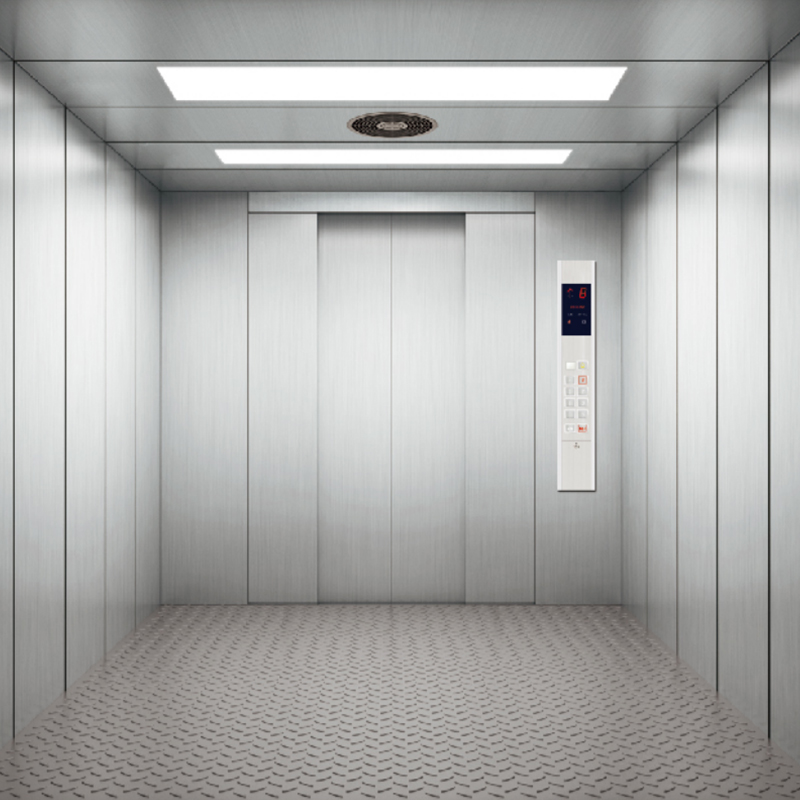
Commercial Hairline Stainless Steel Freight Elevator with Fluorescent Lighting
1. The Role of a Freight Elevator in Modern Commercial Buildings
Freight elevators are essential wherever materials must be transported vertically in a safe and organized manner. Retail buildings may require the movement of boxed products from receiving areas to sales floors. Shopping malls may need to transfer display equipment, cleaning supplies, promotional materials, and replacement stock. Warehouses, hotels, hospitals, factories, and mixed-use buildings may rely on freight elevators for routine logistics that would be impractical or unsafe using passenger elevators.
A commercial freight elevator faces a different operating environment from a conventional passenger elevator. Its interior may be exposed to carts, pallets, packaging materials, metal containers, hand trucks, and repeated loading activity. Doors may open frequently, traffic may be concentrated during particular hours, and the car floor may experience greater mechanical stress than a decorative passenger cabin. These conditions require durable finishes, dependable drive control, accurate stopping, and carefully coordinated safety devices.
The elevator must also fit the operational expectations of a modern commercial property. Building users expect short waiting times, smooth travel, clear indicators, easy access, low vibration, and low noise. Facility managers require straightforward maintenance, useful diagnostic information, dependable components, and service support that can reduce downtime. Architects and owners may also expect the equipment to harmonize with the building’s interior design rather than appear purely industrial.
The TO-J22H addresses these requirements through an integrated design approach. Its construction combines the functional strength expected from a freight elevator with the clean finish associated with commercial interiors. The hairline stainless steel surfaces provide visual consistency, while the riffled plate floor is intended to provide a practical walking and loading surface. The control system coordinates movement, doors, leveling, indicators, and safety functions as one operating platform.
2. Main Product Configuration
The TO-J22H is a machine room freight elevator configured for commercial applications. Its principal design purpose is the safe and efficient vertical movement of commercial goods, with a layout that also permits the combined transportation of goods and passengers where the building’s operating plan and applicable regulations allow it.
The elevator is equipped with a modern VVVF control system. VVVF, or variable-voltage variable-frequency control, manages motor speed and torque during starting, acceleration, deceleration, leveling, and stopping. Instead of relying on abrupt transitions, the system can adjust movement progressively. This contributes to a smoother ride, improved floor accuracy, reduced mechanical shock, and more comfortable loading and unloading.
The car uses high-intensity hairline stainless steel for the ceiling, car walls, and car door. Hairline finishing creates a directional brushed appearance that is appropriate for commercial environments. It helps establish a professional visual standard while providing a surface selected for practical durability and easier routine cleaning than many highly decorative finishes.
The car floor is specified as a riffled plate. Its raised pattern can improve traction compared with a smooth metal surface, which is valuable when operators are moving carts or handling goods. It also provides a strong industrial character suitable for a freight application. Fluorescent lighting is incorporated into the car design to provide useful illumination during loading, inspection, and transportation.
Multiple door-opening modes are available to meet different building layouts. The listed configurations include side opening, center-opening double-folded, one-way opening, and opposite door opening. This flexibility allows the elevator to be coordinated with corridors, loading zones, storage areas, sales floors, service passages, or other architectural conditions.
Product model |
TO-J22H |
Product category |
Machine room freight elevator |
Primary application |
Commercial goods transportation and controlled combined goods-and-passenger use |
Control technology |
VVVF drive and advanced CPU-based control system |
Ceiling finish |
Hairline stainless steel |
Car wall finish |
Hairline stainless steel |
Car door finish |
Hairline stainless steel |
Lighting |
Fluorescent lamp arrangement |
Car floor |
Riffled plate |
Door options |
Side opening, center-opening double-folded, one-way, and opposite door opening |
3. Hairline Stainless Steel for Commercial Durability
Material selection is one of the most important factors in freight elevator design. A commercial car must withstand repeated contact with goods and equipment while continuing to present a clean and orderly appearance. Hairline stainless steel is well suited to this purpose because it combines a refined appearance with a practical surface structure.
The brushed direction of a hairline finish gives the interior a consistent visual texture. This can help reduce the prominence of minor marks that may be more noticeable on a mirror-polished surface. In a busy commercial environment, where carts and packages may enter and leave the car many times a day, this characteristic is valuable for preserving a professional appearance between cleaning cycles.
Using the same general finish on the ceiling, walls, and car door creates a coordinated cabin interior. The result is more unified than a car assembled from unrelated decorative materials. It also allows the freight elevator to serve in customer-facing areas, back-of-house retail zones, shopping centers, and modern commercial buildings where service equipment is visible to employees or visitors.
The material specification supports more than aesthetics. Stainless steel is commonly selected for elevator interiors because it is robust, cleanable, and compatible with demanding service conditions. Proper fabrication, precise cutting, controlled forming, and accurate installation are necessary to obtain the full benefit of the material. The manufacturing process must ensure that panels are correctly aligned and that edges, joints, doors, and protective components are finished to a suitable commercial standard.
Compared with a basic painted-steel freight car, the TO-J22H offers a more polished appearance and a surface specification that is better suited to buildings where the elevator is part of the public or semi-public environment. Compared with an overly decorative passenger elevator, it offers a more practical interior designed for freight-related activity. This balance is one of the product’s important competitive strengths.
4. VVVF Control for Smooth and Precise Movement
Elevator performance depends greatly on how the drive system manages the motor. A freight elevator that starts too abruptly can create uncomfortable acceleration and place unnecessary stress on the load, car structure, and mechanical components. A system that decelerates poorly may produce vibration, inaccurate stopping, or a level difference between the car floor and landing.
The TO-J22H uses VVVF technology to control speed and torque with greater precision. The drive system can adapt the motor’s electrical frequency and voltage during different stages of travel. This supports controlled starting, smooth acceleration, stable high-speed movement, gradual deceleration, and accurate leveling at the destination floor.
Precise leveling is especially important for freight applications. When the car stops flush with the landing, operators can move carts and goods across the threshold with less interruption. A consistent level transition reduces the risk of wheels catching at the entrance and helps make loading more efficient. It also supports accessibility and safer movement for passengers or staff who may enter the car.
The product information emphasizes constant torque and subtle processing. In practical terms, this means that the control system is designed to maintain stable motor performance while making fine adjustments during travel. The objective is not only speed, but also controlled movement, low vibration, and predictable stopping behavior.
Compared with older fixed-speed or less advanced control arrangements, VVVF technology can provide a more refined operating experience. It may also reduce mechanical shock during frequent starts and stops. For a building with intensive traffic, this combination of smoother movement and more accurate control can contribute to greater user confidence and better long-term equipment performance.
5. Steady, Quiet, and Low-Vibration Operation
Noise and vibration are significant concerns in commercial buildings. An elevator that generates harsh mechanical sounds can disturb retail spaces, offices, hotels, medical areas, or residential zones located near the shaft. Excessive vibration can also affect the perceived quality of the building and may indicate that movement, braking, or mechanical alignment needs improvement.
The TO-J22H incorporates a specific purpose holster and an advanced brake system to support steady operation. Together with VVVF control, these elements are intended to reduce abrupt movement and maintain a controlled travel profile. The design objective is a freight elevator capable of handling substantial commercial activity without producing an unnecessarily disruptive operating environment.
Quiet operation is particularly valuable in shopping centers and department stores. Goods may need to be transported while customers are present, and service routes may pass close to public areas. Reducing vibration and noise helps staff work more efficiently and allows the elevator to function in a broader range of building locations.
Low vibration also benefits the transported cargo. Sensitive products, display items, packaged goods, and equipment may be affected by repeated jolts or rough stopping. Although every cargo application requires appropriate loading procedures and compliance with rated capacity, smoother elevator movement provides a better foundation for protecting goods during routine transportation.
The combination of steady travel, progressive braking, and accurate leveling gives the TO-J22H an advantage over basic freight elevators that focus only on lifting capacity. Commercial users need dependable movement quality as well as load-handling capability, and the product is designed to address both aspects.
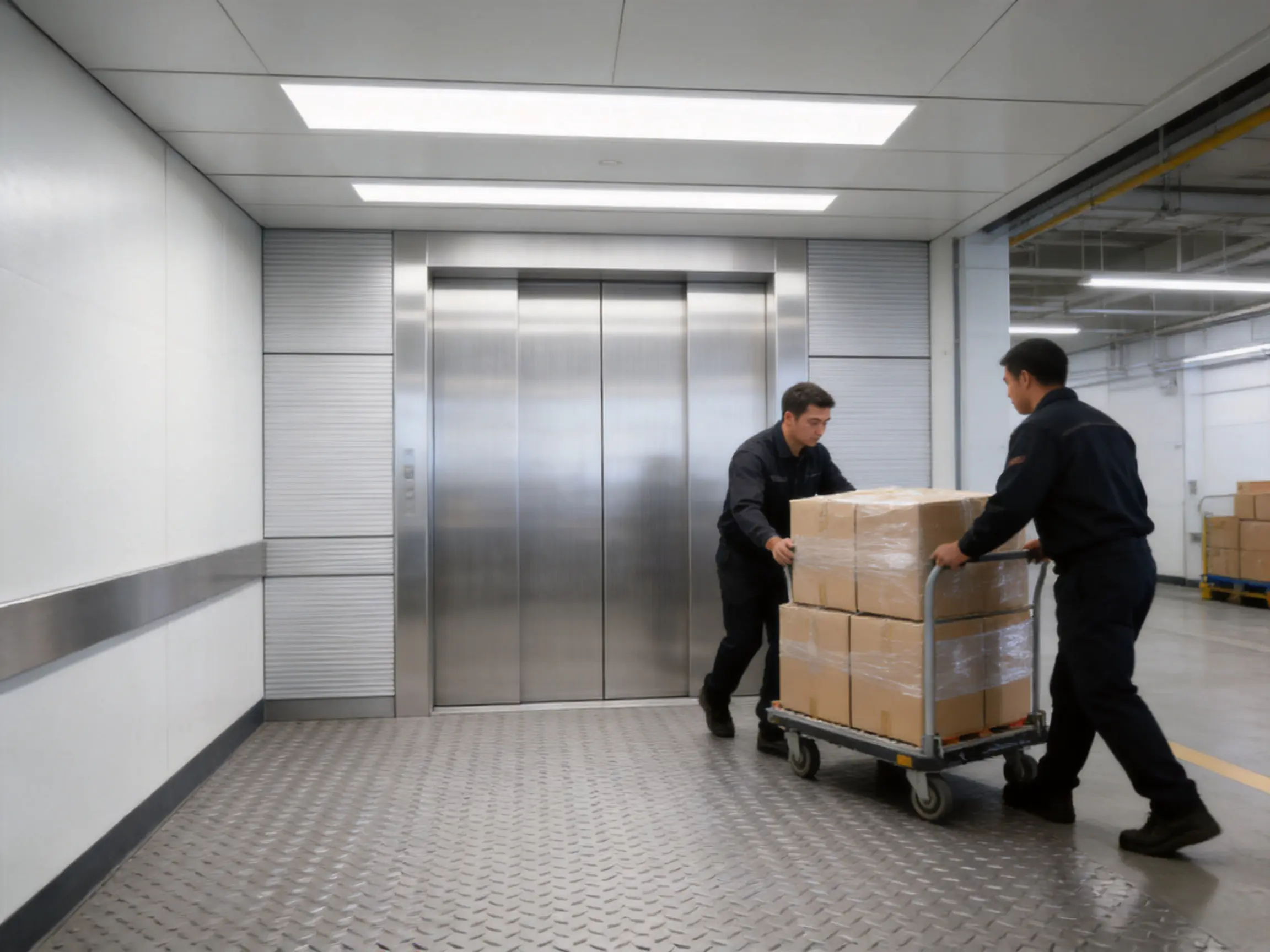
6. Flexible Door Arrangements for Different Building Plans
A freight elevator cannot be evaluated separately from the building around it. The loading point may face a storage corridor, a receiving dock, a service passage, or a public sales area. On another floor, the landing may need to connect with a different corridor orientation or a separate unloading zone. For this reason, door configuration is an important part of elevator planning.
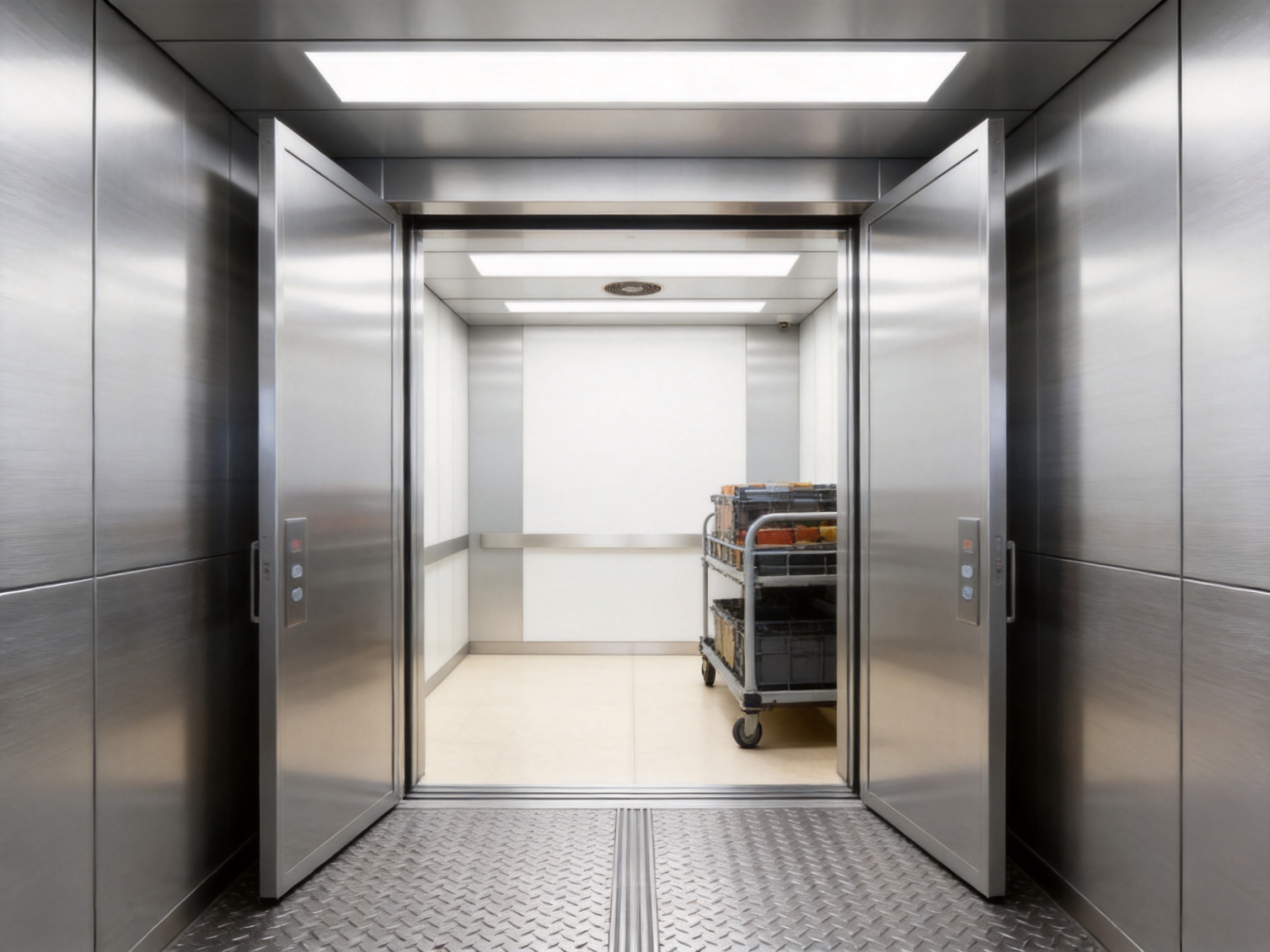
The TO-J22H can be supplied with several opening arrangements, including side opening, center-opening double-folded, one-way, and opposite door opening. These options give architects, contractors, and elevator planners more freedom when coordinating the equipment with the shaft, landing access, and material flow.
A side-opening arrangement can be useful where the landing area or corridor favors lateral movement. A center-opening arrangement may provide a balanced entrance and can be suitable where a symmetrical access point is preferred. One-way opening can serve a straightforward single-side traffic plan, while opposite door opening can support through-car movement between two sides of a building.
Opposite door access is particularly useful in some logistics plans because goods can enter from one side and leave from the other without requiring a full turn inside the car. This may improve workflow in receiving, storage, and distribution areas. The appropriate configuration depends on the architectural plan, traffic pattern, required clearances, and local technical requirements.
The availability of multiple options is a competitive advantage over standardized freight elevator designs that provide only one door arrangement. It can reduce the need for architectural compromises and help integrate the elevator into existing or new commercial buildings more effectively.
7. Safety Systems for Commercial Freight Operation
Safety is the foundation of any elevator system, and freight elevators require a comprehensive approach because they may be exposed to frequent loading, varied cargo shapes, intensive door cycles, and mixed operating conditions. The TO-J22H is described as incorporating safety components manufactured in accordance with international standards and includes several layers of operational protection.
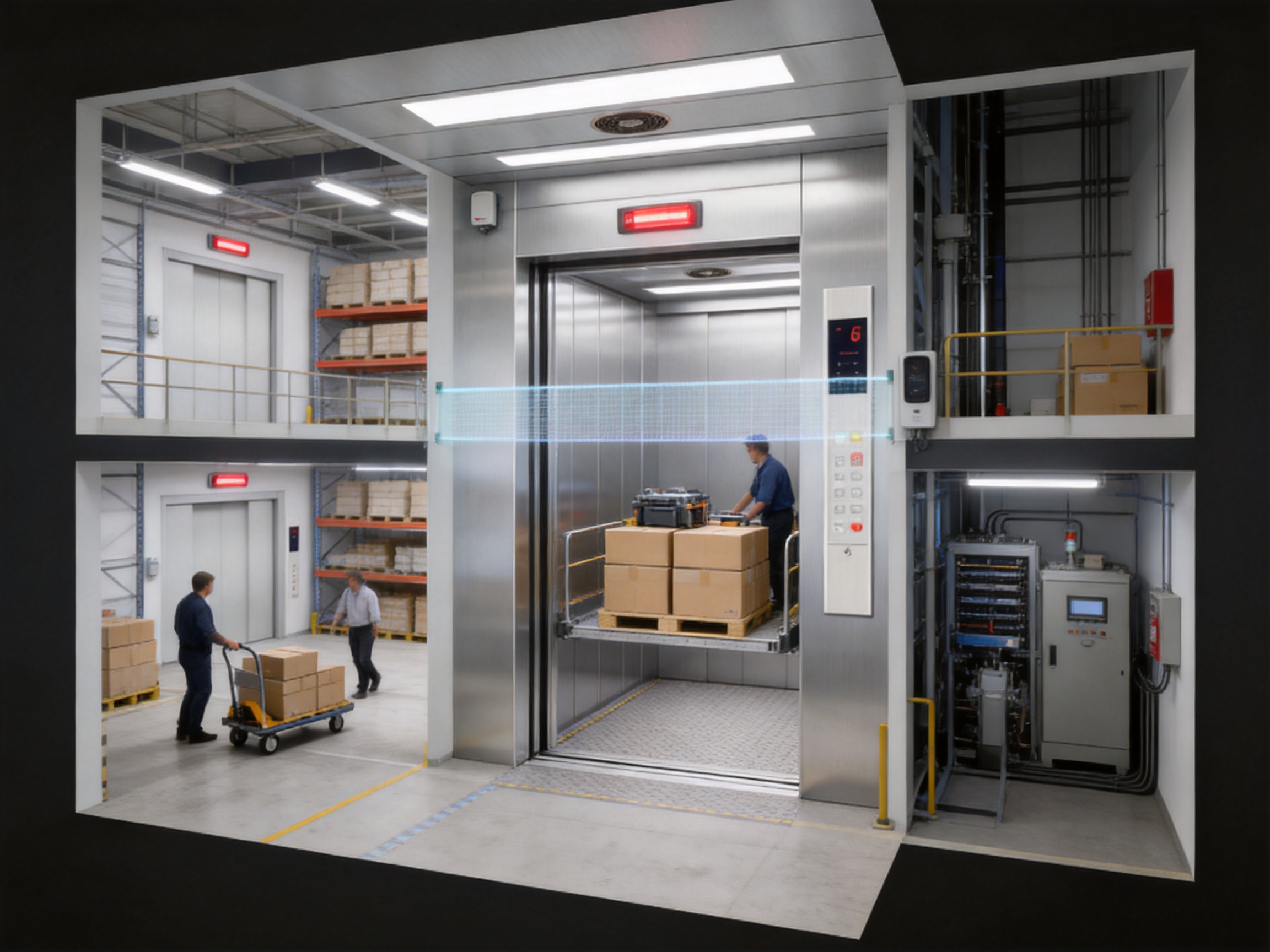
Light curtain sensors are used to detect obstructions across the entrance area. If an object or person interrupts the protected zone while the doors are closing, the system can respond by preventing unsafe closure or initiating reopening according to the control sequence. This is important when workers are guiding carts, handling packages, or moving through the entrance.
Overload protection helps prevent operation when the car load exceeds the configured limit. This function supports safe operating discipline and helps protect the traction, braking, suspension, and structural systems from excessive loading. Proper weighing, loading distribution, and adherence to the rated capacity remain essential responsibilities for building operators.
Door interlock protection ensures that the elevator cannot travel normally unless the landing and car doors are correctly secured. Door machine safety functions help coordinate opening and closing movement, detect abnormal conditions, and support reliable door operation during repeated commercial use.
Upward and downward overspeed protection provides an additional layer of defense against abnormal travel conditions. Main contactor monitoring can help identify problems in the power-control chain. These functions are complemented by safety stop features and other components designed to respond to irregular operating conditions.
Fire emergency return is included as a standard function in the listed configuration. Emergency car lighting is also provided so that occupants are not left without illumination in the event of a power or system interruption. Depending on the building design and applicable regulations, additional emergency functions and interfaces may be specified during project engineering.
No elevator safety system replaces proper installation, inspection, maintenance, operator training, or compliance with local codes. However, a layered design that combines mechanical safety components, electronic monitoring, door protection, overload control, emergency functions, and clear operating information provides a strong foundation for dependable commercial service.
8. Intelligent Control and User Convenience
Commercial elevator users are affected by many small operating details. A car that reopens correctly when a hall call is registered, a door that remains open long enough for a cart to pass, and a clear arrival indicator can make a significant difference during busy periods. The TO-J22H includes a range of functions intended to improve daily convenience and traffic coordination.
The control system supports micro-touch buttons and intelligent operating features. Automatic door-holding adjustment can help adapt door-open time to operating needs. Door control can be coordinated for different configurations, including double-door operation where applicable. An optional IC card system can restrict access to selected floors or commercial zones, which is useful for stockrooms, service areas, offices, and other controlled locations.
Floor and direction indicators are provided in both the car and hall. These indicators help users understand the elevator’s current position, travel direction, and arrival status. Car arrival chimes provide an audible signal that can be useful in busy corridors or for users whose attention is not directed toward the display.
Five-way communication is included as part of the information and communication functions. Communication systems are important for emergency response, maintenance coordination, and contact between the elevator car and designated support personnel. Voice announcements may be available as an option to provide additional instructions and floor information.
Automatic ventilation contributes to a more comfortable interior, especially when the car is used frequently or remains occupied during loading operations. Reopen-with-hall-call functions and door-opening time extensions can help reduce interruptions during active traffic periods. The control system can also support the behavior of stopping and opening at designated floors to streamline commercial movement.
These features distinguish the TO-J22H from a basic cargo lift that provides only simple up-and-down transport. The product is designed as an integrated commercial transportation system, combining movement, communication, access control, comfort, information, and safety within one coordinated platform.
9. Practical Floor and Interior Design
The interior of a freight elevator must be designed around real work. Operators need enough visual clarity to position carts, recognize obstacles, inspect cargo, and keep the cabin orderly. The TO-J22H uses fluorescent lighting to provide direct illumination throughout the car. This supports loading and unloading at different times of day and in buildings where ambient lighting may be limited.
The lighting arrangement is also useful during cleaning and maintenance inspections. A well-lit car makes it easier to identify damage, spilled materials, packaging debris, or objects that have been left behind. For building managers, visibility contributes to better housekeeping and more consistent facility standards.
The riffled plate floor is an appropriate choice for a commercial freight environment. Its patterned surface is practical for foot traffic and the movement of wheeled equipment. It can provide a more secure walking surface than a completely smooth plate, particularly when operators are moving carefully loaded carts through the entrance.
Interior materials should always be matched with proper loading procedures. Heavy items should be distributed rather than concentrated in one area, and cargo should be secured when required. The floor finish supports operational safety, but it does not eliminate the need for trained personnel, suitable carts, and correct weight distribution.
The combination of stainless steel surfaces, fluorescent lighting, and riffled plate flooring gives the car a clear commercial identity. It is functional enough for demanding service use while maintaining a level of finish suitable for modern retail and institutional buildings.
10. Manufacturing Strength and Engineering Capability
The performance of a freight elevator depends not only on the visible car interior or the selected control functions. It also depends on the manufacturer’s ability to design, process, assemble, test, install, and support the complete system. Tenau Elevator (China) Co., Ltd. operates as a comprehensive elevator manufacturer integrating design, research and development, manufacturing, marketing, installation, and after-sales service.
This integrated capability is important because elevator projects involve many connected disciplines. Mechanical components, electrical control, car construction, door systems, shaft interfaces, safety devices, communication equipment, and building requirements must work together. A manufacturer that can coordinate these activities internally may be better positioned to maintain consistency from engineering design through commissioning.
The company’s manufacturing base is located in Nanxun, Zhejiang Province, within the Shanghai-Nanjing-Suzhou-Hangzhou economic circle. The company information describes a large-scale manufacturing operation supported by professional personnel, automated production lines, German Industry 4.0 intelligent manufacturing concepts, big data, Internet of Things technology, and a closed-loop quality control system.
For a product such as the TO-J22H, advanced manufacturing can influence performance in several ways. Digital production systems can help manage component information and process sequencing. Automated equipment can support repeatable cutting, forming, welding, machining, surface treatment, and assembly operations. Data collection can assist quality tracking and help identify process deviations before they become field problems.
Precision mechanical processing is particularly relevant to the hairline stainless steel car. Panels must be cut accurately, formed consistently, and fitted with carefully controlled joints. Door components require correct alignment and smooth movement. The car structure must be assembled with attention to dimensional accuracy, rigidity, and compatibility with the drive and safety systems.
The company also reports capabilities across low-speed, medium-speed, high-speed, and ultra-high-speed elevator development. This broad technical range demonstrates experience with different transportation requirements and control challenges. Although the TO-J22H is a commercial freight model, the engineering knowledge used across a wider elevator portfolio can support the development of reliable control, safety, and mechanical solutions.
11. Quality Management and Process Control
Quality in elevator manufacturing must be built into the process rather than inspected only at the end. A freight elevator contains many safety-critical and performance-critical components. Inconsistent dimensions, inadequate surface treatment, incorrect wiring, poor alignment, or incomplete testing can affect service reliability and user confidence.
Tenau reports compliance with ISO9001 quality management, ISO14001 environmental management, and OHSMS18001 occupational health and safety management systems. These management frameworks indicate a structured approach to quality, environmental responsibility, and workplace safety. Their value depends on consistent implementation throughout engineering, procurement, production, testing, installation, and service.
A closed-loop quality control system can connect production information with inspection results, corrective actions, and improvement activities. This type of approach is beneficial for a freight elevator because recurring issues can be analyzed rather than treated as isolated events. Traceable records can also help service teams understand product configuration and maintenance history.
Environmental management is increasingly important in the elevator industry. Efficient use of materials, responsible production planning, controlled waste, and attention to energy consumption can influence the overall sustainability profile of a project. The company’s stated environmental protection mission reflects the growing expectation that industrial manufacturers should consider more than product output alone.
Occupational health and safety management is also connected to product quality. A well-controlled manufacturing environment helps protect workers while supporting stable production. Safe processes are more likely to be documented, repeatable, and continuously improved, which can contribute to more consistent elevator components and assemblies.
12. Advantages Over Basic or Less Specialized Competitors
The TO-J22H competes in a market that includes basic cargo lifts, standard freight elevators, general-purpose passenger elevators, and highly customized logistics systems. Its main advantage is the balance it provides between freight-oriented durability, commercial appearance, intelligent control, and flexible project integration.
Compared with a basic cargo lift, the TO-J22H offers a more complete user experience. It includes VVVF control, precise leveling, communication functions, indicators, emergency lighting, light curtains, overload protection, fire emergency return, and optional access control. These functions support a more organized and professional operating environment.
Compared with a conventional passenger elevator adapted for occasional goods use, the TO-J22H provides a more appropriate interior specification. Hairline stainless steel panels and a riffled plate floor are selected for commercial service conditions, while the freight-oriented configuration supports regular loading activity. This reduces the need to compromise between appearance and practical use.
Compared with a rigid standardized product, the TO-J22H provides several door-opening arrangements. This helps it respond to different building plans and can improve the movement of goods through receiving, storage, service, and sales areas. Architectural flexibility can be especially valuable in renovation projects, where shaft positions and corridor layouts may already be fixed.
Compared with older control technologies, the VVVF system offers a more controlled travel profile, smoother acceleration and deceleration, and better leveling. These characteristics can improve comfort, reduce vibration, and make loading more efficient. The value is particularly clear in buildings where the elevator operates frequently throughout the day.
Compared with manufacturers that focus only on equipment supply, Tenau offers a broader service structure covering design, research and development, manufacturing, installation, marketing, and after-sales support. This integrated model can simplify project communication and create a clearer path for maintenance and long-term service.
Competitive advantage should always be assessed against the specific project requirements, including rated load, speed, shaft dimensions, travel height, door size, local regulations, duty cycle, and environmental conditions. Nevertheless, the TO-J22H’s combination of features gives it a strong position for commercial freight applications requiring more than basic vertical lifting.
13. Application Scenarios
Shopping Centers and Department Stores
Retail buildings need reliable separation or coordination between public circulation and goods movement. The TO-J22H can support the transfer of merchandise, displays, cleaning equipment, packaging, and maintenance materials between receiving areas, stockrooms, and sales floors. Its commercial finish is suitable for buildings where service elevators may be visible to staff or customers.
Warehouses and Distribution Areas
In warehouses, accurate leveling and a practical floor surface can support the movement of carts and containers. Flexible door arrangements may help connect different operational zones. The elevator should be planned alongside the building’s loading procedures, traffic management, and cargo protection policies.
Mixed-Use Commercial Buildings
Mixed-use properties often require service equipment that can operate near offices, retail spaces, hotels, or other occupied areas. Quiet and low-vibration movement is valuable in these environments. The stainless steel interior also supports a consistent appearance where back-of-house and public-facing areas are closely connected.
Hotels and Institutional Facilities
Hotels, educational buildings, public facilities, and other institutions may need to transport supplies, furniture, equipment, and maintenance materials without using their primary passenger elevators. The TO-J22H’s communication and emergency features can contribute to organized facility operation when incorporated into a properly planned service route.
Industrial and Service Buildings
Industrial sites may require a durable vertical transportation system for tools, components, packaged products, and maintenance equipment. The machine room arrangement, freight-oriented car, and flexible doors can be evaluated for use in production support buildings and service facilities, subject to the required technical specifications.
14. Installation, Commissioning, and Maintenance Considerations
Successful elevator performance begins with accurate project planning. Before installation, the project team should confirm shaft dimensions, pit conditions, overhead clearance, machine room requirements, landing access, power supply, ventilation, drainage, fire interfaces, and the desired door arrangement. The rated load, speed, stopping accuracy, traffic pattern, and expected duty cycle should also be established.
Installation must be performed by qualified professionals in accordance with the manufacturer’s technical documentation and applicable local regulations. Guide rails, doors, car components, traction equipment, controllers, safety devices, wiring, and communication systems must be installed and adjusted correctly. The final configuration should be checked against approved drawings and project specifications.
Commissioning should include functional testing of travel, acceleration, deceleration, leveling, doors, indicators, lighting, ventilation, communication, overload protection, light curtains, emergency lighting, fire emergency return, and safety stop functions. Testing procedures should be documented, and any adjustments should be completed before the elevator enters regular service.
Routine maintenance is essential for maintaining reliability. Maintenance personnel should inspect door operation, rollers, locks, brake performance, traction components, control equipment, safety devices, indicators, lighting, and communication systems. The stainless steel interior and riffled plate floor should also be cleaned and checked for damage or loose components.
Tenau describes a global marketing service network, personalized client data files, customized maintenance schedules, remote monitoring, and all-day customer support. These services can help building owners organize maintenance according to actual traffic patterns. A high-use shopping center may need a different service strategy from a low-frequency warehouse or institutional facility.
Remote monitoring can provide useful information about operating status, fault conditions, travel activity, and maintenance needs. When combined with professional inspection and on-site service, monitoring can help reduce unexpected downtime. It should complement, rather than replace, statutory inspections and qualified maintenance work.
15. Data-Based and Personalized After-Sales Service
Elevator service requirements vary considerably between buildings. A commercial mall may experience concentrated traffic during evenings and weekends. A distribution center may have high activity during delivery windows. A hotel may require service access throughout the day, while an institutional building may operate according to a fixed schedule.
Personalized client data management allows maintenance planning to reflect these differences. Equipment records can include the elevator model, configuration, door arrangement, installation information, replacement components, service history, and observed operating patterns. Such records help service teams understand the specific equipment rather than treating every elevator as an identical unit.
Customized maintenance schedules can support preventive work before small issues become major interruptions. Door performance, leveling behavior, braking, unusual noise, and communication faults can be tracked over time. Data-based service also helps owners plan budgets, replacement parts, inspections, and future modernization decisions.
The combination of remote monitoring and professional support creates a more responsive maintenance structure. When a problem is detected, preliminary information may be available before a technician reaches the site. This can improve preparation and reduce the time required for diagnosis, although the exact monitoring functions depend on the project configuration and selected options.
For commercial property owners, service continuity is a financial and operational concern. A freight elevator that is unavailable may delay inventory movement, interrupt store replenishment, and create additional pressure on passenger or alternative service elevators. A manufacturer that supports the full product life cycle can help reduce these risks through planned maintenance and timely technical assistance.
16. Sustainability and Long-Term Value
Long-term value in an elevator is influenced by more than initial purchase price. Energy use, maintenance requirements, replacement parts, downtime, service life, interior durability, and adaptability to changing building needs all affect the total cost of ownership. A well-controlled elevator can provide value by operating smoothly, reducing unnecessary mechanical stress, and supporting efficient traffic movement.
VVVF control can contribute to efficient motor management by adjusting speed and torque according to the travel phase. Accurate leveling can shorten loading and unloading interruptions. Reliable door control can reduce repeated obstruction cycles. These operational improvements may support better building efficiency, although actual energy performance depends on load, traffic, motor specifications, standby settings, building conditions, and maintenance quality.
Durable interior materials can also contribute to longer service value. Hairline stainless steel is selected for its suitability in a demanding commercial environment, while the riffled plate floor is designed for practical freight use. A car that maintains its appearance and function over time may require fewer disruptive interior repairs or replacements.
Environmental responsibility is part of the company’s stated mission and management framework. The reported ISO14001 environmental management system provides a structured basis for addressing environmental issues in manufacturing and operations. Sustainable performance should be evaluated across the full project, including production, transportation, installation, use, maintenance, modernization, and eventual component replacement.
17. Recommended Project Evaluation Checklist
Before ordering a commercial freight elevator, the project team should verify the required load, car dimensions, door clear opening, travel height, number of stops, rated speed, machine room arrangement, and duty cycle. These technical parameters determine whether the selected configuration is suitable for the intended goods and traffic conditions.
The building plan should be reviewed to select the correct door-opening mode. The location of receiving areas, storage rooms, sales floors, service corridors, and opposite-side exits should be considered. If through-car movement is required, opposite door opening may be appropriate, but the shaft and landing arrangement must be designed accordingly.
Interior requirements should also be confirmed. The TO-J22H specification includes hairline stainless steel ceiling, walls, and car door, fluorescent lighting, and a riffled plate floor. Project stakeholders should verify whether additional handrails, protective bumpers, special wall protection, ventilation requirements, access control, voice announcements, or monitoring functions are needed.
Safety and regulatory requirements must be reviewed with qualified local professionals. The project should identify applicable elevator codes, fire requirements, electrical standards, accessibility provisions, inspection rules, and occupational safety procedures. The manufacturer’s standard functions and optional features should be matched to the building’s approval documents.
Finally, the owner should evaluate service arrangements. Maintenance response times, spare parts availability, remote monitoring, training, inspection support, warranty terms, and long-term modernization planning should be discussed before installation. These factors can have a major influence on operational reliability after handover.
18. Questions and Answers
Q1: What type of elevator is the TO-J22H?
The TO-J22H is a machine room freight elevator designed for commercial goods transportation. Its configuration also supports the combined transportation of goods and passengers where permitted by the building’s operating plan and applicable regulations.
Q2: What materials are used inside the car?
The ceiling, car walls, and car door use hairline stainless steel. The car floor is specified as a riffled plate, and fluorescent lighting is included for practical illumination during loading, unloading, inspection, and travel.
Q3: Why is hairline stainless steel suitable for a freight elevator?
Hairline stainless steel provides a professional brushed appearance and a practical finish for commercial environments. It is selected to support durability, cleanability, and visual consistency in a car that may experience frequent daily use.
Q4: What is the benefit of VVVF control?
VVVF control manages motor voltage and frequency during starting, acceleration, deceleration, and leveling. It supports smoother movement, reduced vibration, improved stopping accuracy, and a more comfortable operating experience.
Q5: Which door-opening options are available?
The listed options include side opening, center-opening double-folded, one-way opening, and opposite door opening. The most suitable arrangement depends on the building layout, shaft design, corridor access, and goods-flow requirements.
Q6: Does the elevator include overload protection?
Yes. Overload protection is included among the listed safety functions. It helps prevent normal operation when the load exceeds the configured capacity. Operators must still follow correct loading procedures and observe the rated capacity.
Q7: What communication and information functions are provided?
The elevator includes floor and direction indicators in the car and hall, car arrival chimes, five-way communication, and self-diagnosis functions. Voice announcements and traction machine monitoring may be available as optional features.
Q8: Is emergency lighting included?
Yes. Emergency car lighting is identified as a standard emergency response feature. Fire emergency return and safety stop functions are also included in the listed configuration, subject to project requirements and applicable regulations.
Q9: Can access to certain floors be restricted?
An IC card access system is available as an option. It can help restrict access to selected floors or commercial zones such as stockrooms, offices, service areas, or staff-only spaces.
Q10: How does precise leveling help freight operations?
Precise leveling keeps the car floor closely aligned with the landing floor. This makes it easier to move carts and goods across the entrance and reduces the risk of wheels catching at a height difference.
Q11: What buildings may use this elevator?
Potential applications include shopping centers, department stores, warehouses, distribution areas, mixed-use commercial properties, hotels, institutions, industrial service buildings, and other facilities requiring dependable vertical transportation for goods.
Q12: What manufacturing capabilities support the product?
Tenau Elevator integrates design, research and development, manufacturing, installation, marketing, and after-sales service. The company describes automated production lines, Industry 4.0 intelligent manufacturing, big data, Internet of Things technology, and closed-loop quality control.
Q13: Which management systems does the company report?
The company reports ISO9001 quality management, ISO14001 environmental management, and OHSMS18001 occupational health and safety management systems. These frameworks support structured quality, environmental, and workplace safety processes.
Q14: What should be confirmed before ordering?
The project team should confirm rated load, car dimensions, door size and arrangement, speed, travel height, number of stops, machine room conditions, power supply, building codes, fire interfaces, interior options, traffic patterns, maintenance requirements, and desired monitoring or access-control functions.
19. Conclusion
The TO-J22H commercial hairline stainless steel freight elevator is designed for buildings that require a dependable, professional, and adaptable solution for vertical goods transportation. Its freight-oriented construction is combined with a commercial interior, modern VVVF control, accurate leveling, multiple door arrangements, comprehensive safety functions, clear information systems, and practical convenience features.
The product’s advantages are especially clear when compared with basic cargo lifts or passenger elevators that have been adapted for occasional goods use. It provides a more balanced combination of durability, appearance, control quality, operating comfort, safety, and architectural flexibility. The hairline stainless steel interior supports a refined commercial environment, while the riffled plate floor and fluorescent lighting serve practical loading and service needs.
Behind the product is a manufacturing organization with capabilities covering engineering, research and development, production, installation, and after-sales support. Automated manufacturing, Industry 4.0 methods, data technology, closed-loop quality control, and reported ISO management systems provide a structured foundation for consistent product development and delivery.
For shopping centers, warehouses, department stores, mixed-use buildings, institutions, and industrial service facilities, the TO-J22H can be evaluated as a complete commercial transportation solution rather than simply a lifting device. When properly specified, installed, maintained, and operated, it can support safer goods handling, smoother traffic flow, improved building service, and dependable long-term performance.
References
1. Product specification and technical description for the TO-J22H machine room freight elevator.
2. Internal product information concerning VVVF control, elevator functions, safety protection, communication features, and commercial applications.
3. Tenau Elevator company information concerning design, research and development, manufacturing, installation, and after-sales service.
4. ISO 9001, Quality Management Systems—Requirements.
5. ISO 14001, Environmental Management Systems—Requirements with Guidance for Use.
6. OHSMS18001 occupational health and safety management system information provided in the manufacturer’s corporate profile.
7. General engineering principles for elevator planning, freight transportation, door coordination, leveling, maintenance, and commercial building logistics.
Product: Commercial Hairline Stainless Steel Freight Elevator with Fluorescent Lighting

Related Products
Related News
Built on safety, forging trust in vertical mobility.
lf you have any questions or need help, feel free to contact with our team.
 export@tenau.com.cn
 +86-18601458867
 +86-512-65059883
Elevator & Escalator
Factory Add
East of Xicheng Road, North of Lianyi Road, Nanxun Economic Development Zone, Nanxun District, Huzhou City, Zhejiang Province, P.R.China
Copyright © Tenau Elevator (China) Co., Ltd. All Rightd Reserved.
Custom High Quality Elevator Suppliers and World Brand Elevator Company