

 en
en Español
 русский
 中文简体
中文简体
Advanced Moving Walkways for Safer, Smoother, and More Efficient Passenger Mobility
Content
- 1 1. The Role of Moving Walkways in Modern Buildings
- 2 2. Product Positioning and Core Advantages
- 3 3. Passenger Comfort: Smooth Movement Like Walking on Level Ground
- 4 4. Safety Protection for Public Confidence
- 5 5. Energy Efficiency Through Variable Frequency Technology
- 6 6. Mechanical Strength and Durable Structure
- 7 7. Intelligent Control and Maintenance Efficiency
- 8 8. Aesthetic Design for Commercial and Public Environments
- 9 9. Arrangement Plans for Different Passenger Flow Strategies
- 10 10. Standard and Optional Functions That Add Value
- 11 11. Competitive Advantages Over Ordinary Moving Walkway Suppliers
- 12 12. Advanced Manufacturing Processes and Intelligent Production Strength
- 13 13. Quality Philosophy and Global Service Capability
- 14 14. Application Scenarios and Practical Benefits
- 15 15. Environmental and Economic Value
- 16 16. Why Manufacturing Strength Matters for Project Owners
- 17 17. Q&A Section
- 17.1 Q1: What types of buildings are most suitable for this moving walkway?
- 17.2 Q2: How does the product help save energy?
- 17.3 Q3: What safety features make the moving walk reliable for public use?
- 17.4 Q4: Why is the trouble indicator important?
- 17.5 Q5: What is the advantage of automatic lubrication?
- 17.6 Q6: How does the product compare with low-cost moving walkways?
- 17.7 Q7: Can the moving walkway be customized for different buildings?
- 17.8 Q8: What manufacturing strengths support the product’s quality?
- 17.9 Q9: Why is after-sales service important for moving walkways?
- 17.10 Q10: What are the main benefits for passengers?
- 18 18. Conclusion
- 19 References
In modern commercial buildings, airports, railway stations, supermarkets, exhibition centers, hospitals, and public transportation hubs, efficient passenger movement is no longer a luxury; it is a core requirement of architectural performance. A moving walkway provides a practical, comfortable, and inclusive transportation solution for large passenger flows, long walking distances, luggage carts, baby strollers, shopping carts, and mobility-impaired users. By combining mechanical reliability, refined appearance, energy-saving control, and comprehensive safety protection, a high-quality moving walk can transform the experience of moving through a building.
The moving walk product described in this article is designed for environments where smooth passenger circulation, stable operation, and long service life are essential. It is especially suitable for shopping malls, supermarkets, airports, subways, pedestrian bridges, large public buildings, and transportation terminals. Its value lies not only in moving people from one point to another, but also in improving convenience, reducing fatigue, supporting commercial flow, and enhancing the overall image of a facility.
Tenau Elevator (China) Co., Ltd. has developed its moving walk solutions around the demands of global markets. The company integrates elevator and escalator manufacturing experience, advanced production lines, intelligent processing equipment, strict inspection procedures, and international service concepts. The result is a product that emphasizes safety, comfort, energy efficiency, aesthetic appeal, maintainability, and customization. For project owners and engineering contractors, these strengths translate into lower operating costs, higher reliability, easier maintenance, and a better passenger experience.
1. The Role of Moving Walkways in Modern Buildings
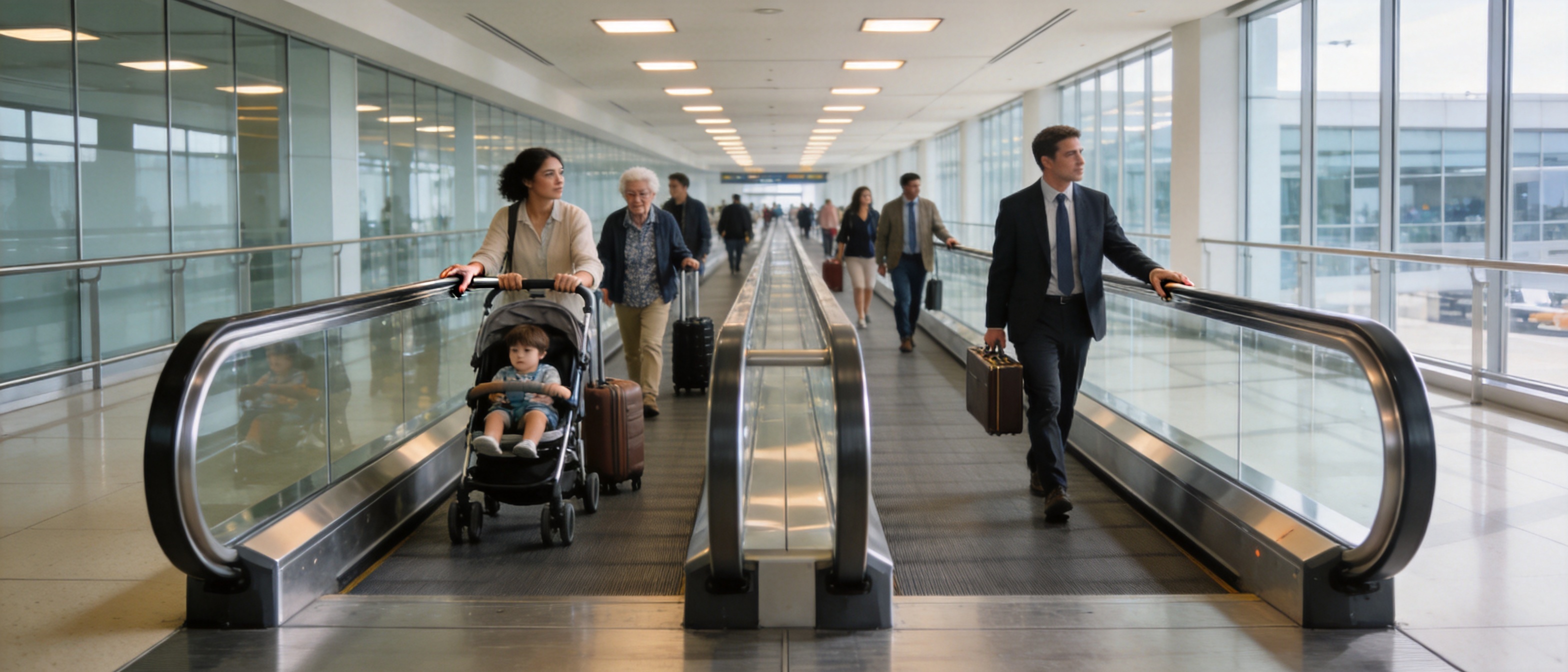
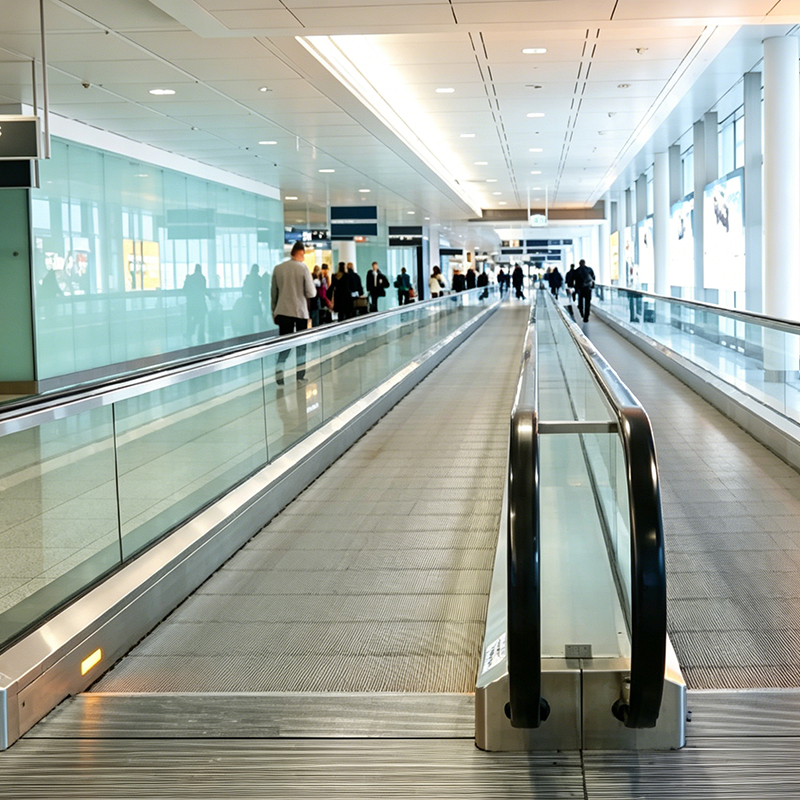
A moving walkway is a continuous passenger conveying system designed to transport people horizontally or along a slight incline. Unlike ordinary corridors, a moving walk actively reduces travel effort and shortens perceived travel time. In large buildings, this feature can significantly improve user satisfaction. In retail spaces, it encourages customers to explore wider areas. In transport hubs, it helps passengers reach gates, platforms, exits, or transfer points more efficiently. In public infrastructure, it improves accessibility and supports inclusive design.
The demand for moving walks has increased because many buildings are becoming larger, more complex, and more multifunctional. A modern airport may require passengers to travel long distances between check-in counters, security areas, terminals, and boarding gates. A shopping center may use moving walks to connect parking levels, retail floors, and supermarket areas. A railway station or subway interchange may need to direct large crowds safely during peak periods. In these scenarios, ordinary walking paths can create fatigue, congestion, and inefficient traffic flow. A moving walk solves these problems by providing continuous, stable, and predictable movement.
The product’s ability to accommodate luggage carts, shopping carts, baby strollers, and mobility aids is one of its greatest practical advantages. For supermarkets and transport terminals, this capability is particularly important. Passengers or shoppers do not need to lift bags or carry heavy loads over long distances. Instead, they can move naturally and safely while remaining in control of their belongings. This inclusive convenience makes the moving walk a valuable investment for facilities that serve diverse user groups.
2. Product Positioning and Core Advantages
The moving walk is engineered for public areas with high passenger flow and frequent daily use. Its design philosophy is based on three important goals: stable transportation, passenger safety, and efficient operation. The product combines durable mechanical structures with intelligent electrical control and visually refined exterior design. It is intended to serve not only as a transportation device, but also as a visible part of a building’s public environment.
Compared with ordinary or low-cost moving walkway solutions, this product places stronger emphasis on the complete life cycle of operation. The buying decision for a moving walk should not be based only on initial price. Owners must also consider power consumption, maintenance frequency, noise level, durability of chains and rollers, safety protection, availability of spare parts, and the manufacturer’s technical response capability. A moving walk with poor components may appear economical at the beginning, but can later create higher maintenance costs, service interruptions, safety risks, and user dissatisfaction.
The product differentiates itself through features such as trouble indication, vertical traction technology, variable frequency control, automatic sensed starting and braking, energy-saving drive design, step or pallet illumination, multiple safety protection functions, and stable structural engineering. These elements work together to support smooth passenger movement, easier maintenance, quieter operation, and reduced energy usage. In competitive projects, such integrated advantages can help building owners achieve stronger value over the long term.
Another advantage is aesthetic flexibility. Public transportation equipment is highly visible. A moving walk installed in a shopping mall, airport, or commercial complex must harmonize with surrounding architecture. The product offers a clean and modern appearance, with handrail belts and fencing board options that can support different interior design styles. A well-designed moving walk does not interrupt the visual language of a building; it contributes to it.
3. Passenger Comfort: Smooth Movement Like Walking on Level Ground
Passenger comfort is one of the defining qualities of a well-designed moving walkway. A moving walk should feel stable, balanced, and natural. Users should be able to step on and off with confidence. The movement should be smooth enough that passengers carrying bags or pushing carts feel secure throughout the ride. The described product is developed around the idea of making movement as easy and comfortable as walking on smooth ground.
Smooth operation depends on the coordination of mechanical and electrical systems. The transmission chain, rollers, traction machine, control system, handrail drive, and truss structure must operate with precision. Any weakness in these elements can create vibration, noise, uneven motion, or premature wear. This product uses carefully designed transmission components and control technology to improve motion consistency. The internally arranged chain-roller structure helps reduce driving noise and supports quieter, smoother travel.
Comfort also includes psychological security. Passengers often judge equipment quality by the way it sounds, feels, and looks. Excessive noise or visible instability can create unease, even if the machine is technically functional. A stable moving walk with soft illumination, clear direction indicators, neat panels, and responsive braking gives users confidence. This confidence is especially important for elderly passengers, children, travelers with luggage, and people using mobility aids.
In retail environments, comfort directly affects commercial behavior. A shopper who can move easily between parking, supermarket, and retail zones is more likely to continue shopping and explore more areas. In airports and stations, comfort reduces stress during time-sensitive travel. In public buildings, it improves accessibility and supports a higher service standard. Therefore, comfort is not only a technical benefit; it is an operational and commercial advantage.
4. Safety Protection for Public Confidence
Safety is the foundation of any passenger conveying equipment. A moving walkway operates in public spaces where thousands of users may pass every day, including people unfamiliar with the facility. For this reason, the product incorporates multiple safety protection functions and warning systems designed to reduce risk and support reliable operation.
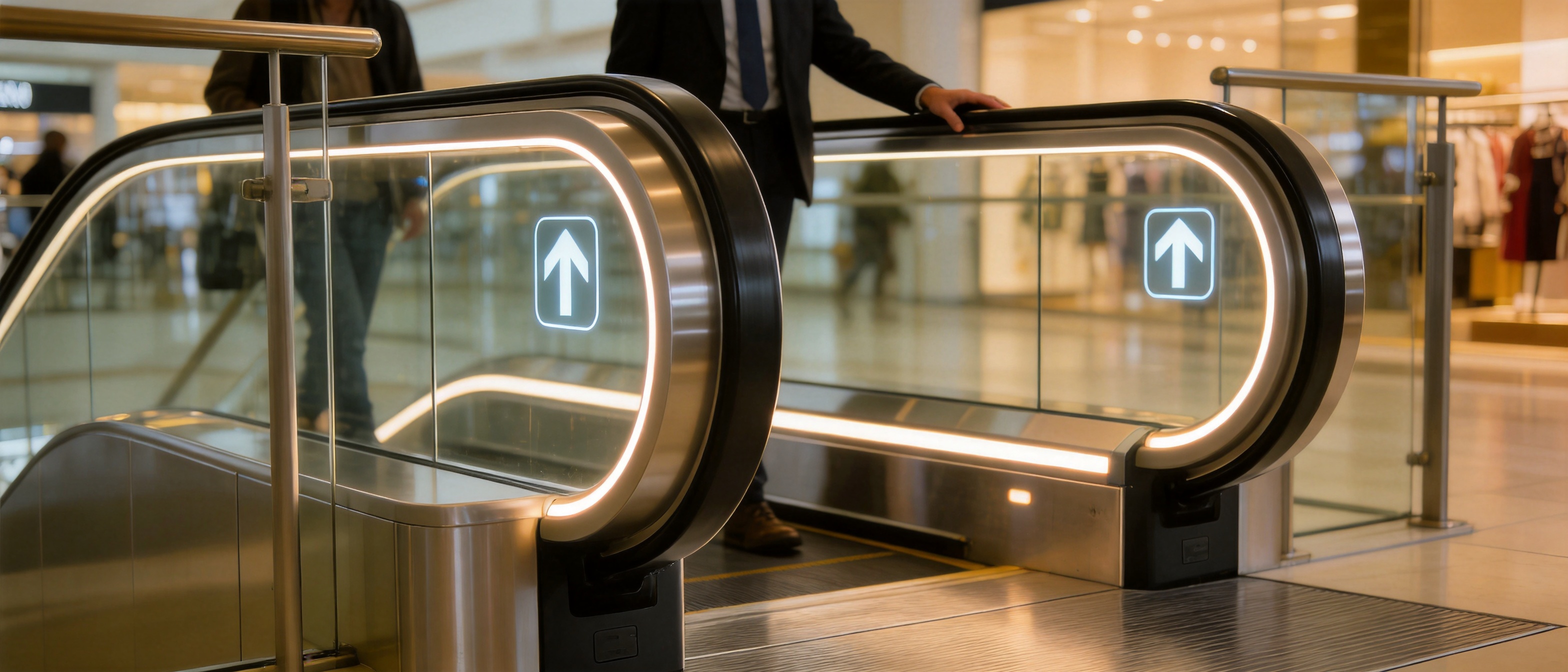
Safety features may include warning lines, passenger illumination, clear running direction indicators, handrail inlet protection, emergency braking devices, and system monitoring. The handrail inlet is designed to be modern and attractive while also helping protect users at entrance and exit areas. Illumination near the steps or pallets helps remind passengers of the entry and exit transitions, making the ride safer and more intuitive.
The trouble indicator is another important safety and maintenance feature. It accurately displays the location of a malfunction, allowing service personnel to identify and address issues more quickly. Fast troubleshooting reduces downtime and helps prevent small issues from developing into larger failures. In high-traffic buildings, the ability to respond quickly to faults is essential for maintaining passenger flow and public order.
The product is designed with strict safety standards in mind. For building owners, this is critical because public transportation equipment must meet regulatory expectations and user expectations at the same time. A moving walk that exceeds ordinary safety requirements can reduce operational risk and strengthen the reputation of the facility. In competitive procurement, proven safety design is one of the most persuasive reasons to choose a higher-quality supplier.
5. Energy Efficiency Through Variable Frequency Technology
Energy consumption is a major concern for facility managers, especially when moving walkways operate for long hours every day. Traditional systems may run continuously at full speed even when no passengers are present. This creates unnecessary electricity consumption and mechanical wear. The product addresses this challenge with variable frequency control and automatic sensed starting and braking technology.
With variable frequency driving, the moving walk can operate at low speed when no passengers are detected and return to normal speed when a passenger approaches. This intelligent adjustment can produce significant energy savings. In suitable operating conditions, energy savings may reach up to 40 percent. For large commercial buildings or transport hubs with multiple moving walks, the cumulative reduction in electricity costs can be substantial.
Energy-saving design also extends equipment life. When a machine does not need to run at full speed continuously, the stress on components can be reduced. Lower mechanical strain may lead to less wear on chains, rollers, bearings, and drive systems. This can reduce maintenance costs and improve long-term reliability. Therefore, energy efficiency should be understood not only as a power-saving function, but also as a life-cycle cost advantage.
Variable voltage variable frequency control also improves ride quality. Smooth acceleration and deceleration reduce sudden movement, making the equipment more comfortable and safer for passengers. This is particularly valuable in locations where users may carry luggage or push carts. The technology supports a more refined user experience while achieving operational efficiency.
6. Mechanical Strength and Durable Structure
The moving walk’s structural integrity is essential to its long-term performance. The truss provides the main support framework, and it must resist load, vibration, environmental factors, and continuous use. A high-quality truss made of strong steel with a carefully engineered structure can improve stability, reduce deformation, and extend equipment service life.
The product uses a durable truss concept with high strength and strong resistance to corrosion. This is important for installations in public buildings where equipment may operate continuously and face changing environmental conditions. In transportation hubs and commercial buildings, maintenance access may be limited, so durability is a key requirement.
Transmission reliability is another structural advantage. The vertical type traction machine is designed for higher transmission efficiency, lower noise, and longer service hours. A reliable traction system helps maintain stable movement under daily passenger loads. The chain and roller design further supports smooth operation and noise reduction. For owners, this means fewer complaints, less downtime, and improved operating confidence.
The moving walk’s careful mechanical design also supports installation flexibility. Depending on the building layout and passenger flow, moving walks can be arranged as a single unit, continuous one-way arrangement, interrupted one-way arrangement, parallel two-way arrangement, or crisscross continuous arrangement. This adaptability makes the product suitable for different architectural and commercial strategies.
7. Intelligent Control and Maintenance Efficiency
A modern moving walkway must be easy to maintain. Maintenance efficiency affects not only service cost but also passenger flow, safety, and facility image. When a fault occurs, service personnel need fast access to diagnostic information. The product’s fault display and monitoring functions are designed to improve this process.
The moving direction and failure display can be mounted near entrance and exit areas. By observing digital readings, maintenance personnel can identify operational problems quickly. This reduces time spent searching for faults and improves repair efficiency. In large facilities, where one service team may handle many units, accurate fault indication is a major advantage.
Automatic lubrication is another important maintenance feature. When lubrication depends only on manual work, inconsistency can lead to premature wear, noise, and component damage. An electric automatic lubrication system controlled by a preset program can activate lubrication at appropriate intervals. This helps protect transmission chains and improves service life. It also supports more standardized maintenance management.
Intelligent remote monitoring can further improve safety and service response. Through advanced monitoring concepts, operational status and safety information can be observed more effectively. When abnormal conditions appear, the system can support faster response and better maintenance planning. This is especially valuable for overseas projects where owners require reliable service standards and preventive maintenance strategies.
8. Aesthetic Design for Commercial and Public Environments
A moving walkway is not hidden machinery. It is a visible part of a building’s passenger environment. Therefore, appearance matters. A well-designed moving walk can enhance the sense of modernity, order, and quality in a public space. The product offers a concise, smooth, and contemporary visual style suitable for modern architecture.
The design includes diversified handrail belts and fencing boards, giving building owners more choices for matching interior themes. Stainless steel panels, clean lines, and dynamic visual rhythm can make the equipment look refined rather than purely industrial. In shopping malls and supermarkets, attractive moving walks can contribute to the commercial atmosphere. In airports and stations, they can reinforce a sense of efficiency and professionalism.
Good design also serves functional goals. Clear entrances and exits, visible direction indicators, comfortable handrail positions, and logical lighting all improve usability. When appearance and function are integrated, passengers can understand and use the equipment more naturally. This reduces hesitation, improves flow, and supports safety.
Compared with competitors that may focus mainly on mechanical function, this product emphasizes the complete user experience. It recognizes that moving walks must perform reliably while also fitting the visual and emotional expectations of modern public spaces. This balanced design approach is an important competitive advantage.
9. Arrangement Plans for Different Passenger Flow Strategies
The correct arrangement of moving walkways can greatly influence passenger flow. A product may be technically excellent, but if it is placed poorly, it cannot deliver maximum value. Different buildings require different layout strategies depending on traffic direction, space availability, commercial objectives, and peak flow patterns.
A single unit is suitable for linking two levels or two areas where passenger traffic mainly flows in one direction. This arrangement can be adjusted flexibly according to daily traffic patterns, such as upward movement in the morning and downward movement in the evening. It is simple, direct, and efficient.
A continuous one-way arrangement is often used in smaller department stores or commercial buildings to connect several levels. It requires more space than interrupted layouts, but it provides a more direct passenger route. This is useful when the objective is to move customers or passengers quickly across multiple connected areas.
An interrupted one-way arrangement may require users to take a short detour before reaching the next unit. Although this can be less direct for passengers, it can be commercially valuable for retail owners. The detour can guide customers past advertising displays, promotional zones, or strategic store entrances. In this sense, the moving walk becomes part of the commercial circulation design.
A parallel interrupted arrangement supports two-way traffic and is useful in department stores and public transport buildings with heavy traffic volume. When three or more units are installed, the travel direction can be reversed according to passenger flow. This arrangement can also be economical because inner lateral claddings may not be required.
A crisscross continuous arrangement is suitable for major department stores, public buildings, and transportation facilities where travel time between several levels should be minimized. It provides a dynamic and efficient layout for heavy traffic environments. Selecting the correct arrangement requires cooperation among architects, owners, engineers, and the moving walkway manufacturer.
| Arrangement Type | Typical Application | Main Advantage | Planning Consideration |
|---|---|---|---|
| Single unit | Two connected levels or long corridors | Simple flow control and flexible direction adjustment | Best for dominant one-way traffic |
| Continuous one-way | Smaller department stores and commercial areas | Direct movement across multiple levels | Requires more continuous space |
| Interrupted one-way | Retail buildings with promotional zones | Guides passengers past displays and stores | Less direct but commercially useful |
| Parallel interrupted two-way | Transport hubs and high-traffic public buildings | Supports heavy bidirectional flow | Direction can be adjusted by traffic demand |
| Crisscross continuous two-way | Large malls, public buildings, and transit centers | Minimizes travel time between multiple levels | Requires coordinated architectural planning |
10. Standard and Optional Functions That Add Value
The product includes a range of standard and optional functions that allow it to meet different project requirements. Standard features help ensure safety, stability, and convenience, while optional features allow building owners to improve comfort, energy performance, and environmental adaptability.
The step chain-roller inbuilt structure is a standard feature designed to reduce noise during the driving process. By integrating the roller into a specially designed chain, the system supports smoother and quieter operation. This is valuable in indoor commercial spaces, where excessive mechanical noise can affect customer comfort.
The handrail inlet is also a standard feature. Its design is modern and attractive while supporting safe entrance and exit movement. Since passengers naturally touch or approach the handrail at these points, the inlet must be both visually refined and functionally protective.
The vertical type traction machine provides higher transmission efficiency, lower noise, and longer service hours. This feature is especially important for buildings with long daily operation periods. A more efficient traction machine can improve system reliability and reduce operating strain.
Moving direction and failure display functions provide practical value for users and service teams. Direction indicators help passengers know whether the equipment is available and moving in the correct direction. Failure displays support faster maintenance response. Together, these functions improve both passenger guidance and technical management.
Passenger illumination is another standard safety feature. Light near the entry and exit areas reminds passengers to pay attention to the level sections. It improves visibility and creates a more secure impression, especially in busy or visually complex public environments.
Optional functions include emergency brake devices, heating devices, variable frequency driving, electric automatic lubrication, and additional running direction indication. Heating devices are useful in colder environments or installations where temperature may affect mechanical performance. Variable frequency driving provides strong energy-saving benefits. Automatic lubrication supports long-term reliability. Optional direction signs improve passenger guidance and reduce misuse.
11. Competitive Advantages Over Ordinary Moving Walkway Suppliers
In a competitive market, many suppliers can provide basic moving walk equipment. However, not all suppliers can provide the same level of integrated value. The difference lies in engineering depth, manufacturing control, safety design, energy performance, customization ability, and after-sales support.
One important advantage of this product is its balance of performance and cost efficiency. Rather than focusing only on low initial cost, it emphasizes reduced energy usage, longer service life, efficient maintenance, and fewer interruptions. For owners, these factors often produce better overall value than choosing a cheaper unit with weaker components.
Another advantage is the combination of advanced technology and practical usability. Features such as fault indication, automatic lubrication, variable frequency control, and passenger illumination are not merely technical decorations. They solve real operating problems: how to reduce downtime, how to save energy, how to guide passengers, how to maintain safety, and how to extend component life.
The product also benefits from manufacturing experience in both elevators and escalators. This broad technical background helps the company understand vertical and horizontal passenger transportation as part of one complete mobility system. For projects that include elevators, escalators, and moving walks, a manufacturer with multiple product capabilities can provide better coordination and more consistent quality.
Customization is another competitive strength. Different markets and buildings have different standards, languages, passenger habits, climate conditions, and architectural styles. The company’s experience serving customers in many countries supports its ability to respond to varied requirements. Multilingual service, professional communication, and project-specific suggestions help reduce misunderstanding and improve cooperation.
12. Advanced Manufacturing Processes and Intelligent Production Strength
A moving walkway’s quality begins long before installation. It begins in design, material selection, processing accuracy, welding quality, panel production, assembly procedures, inspection standards, and final testing. Tenau Elevator (China) Co., Ltd. has developed manufacturing capabilities that support consistent product quality for overseas markets.
The company is located in Huzhou City, Zhejiang Province, close to Shanghai, giving it convenient access to industrial resources, logistics, and international transportation. Its production base has professional elevator and escalator production lines, automatic panel production equipment, and experienced employees. The integration of production resources supports more stable output and stronger control over quality.
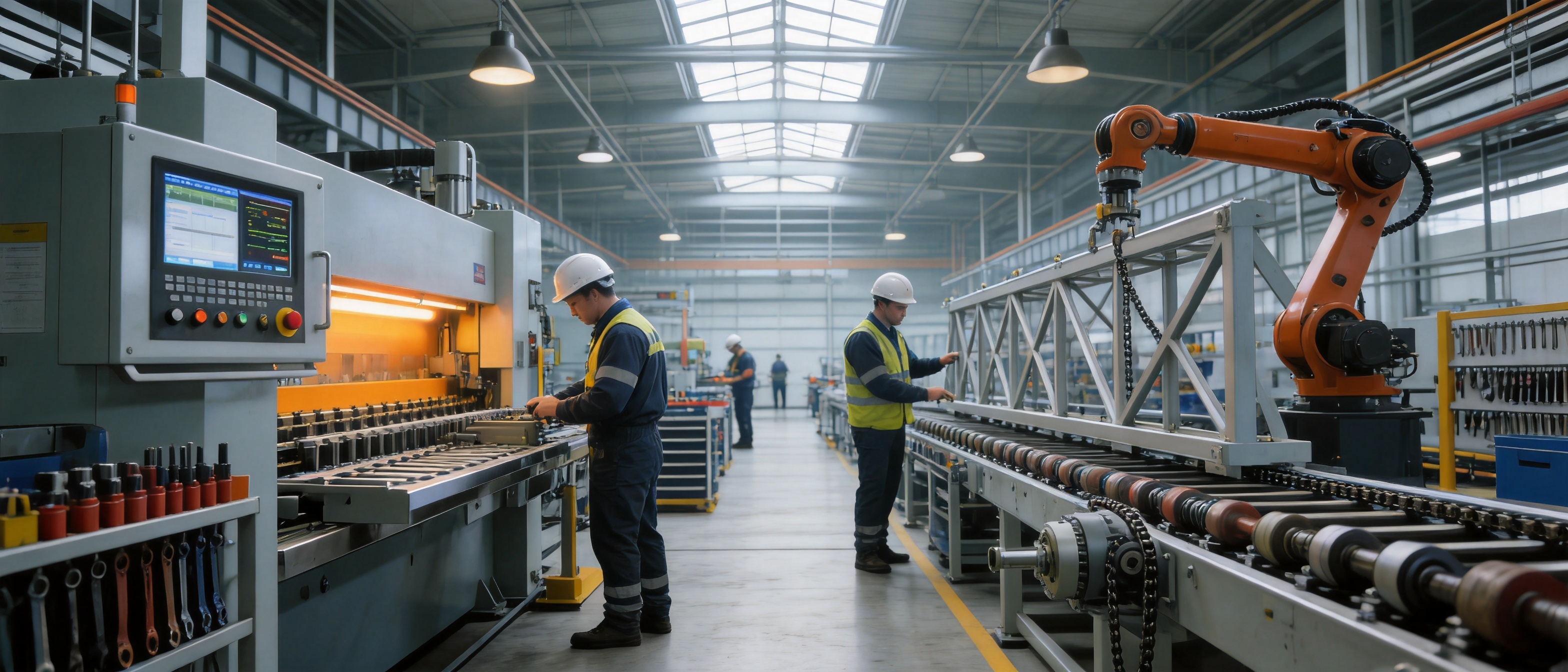
The company’s intelligent production concept is based on modern industrial park planning, efficient operation, green environment, and advanced equipment. The production system integrates automatic processing, intelligent production, intelligent detection, and intelligent monitoring. By combining automated equipment with data-based management and industrial internet concepts, the company aims to improve precision, efficiency, and quality consistency.
Automatic panel production equipment supports better dimensional accuracy and surface quality. In moving walk manufacturing, panels are not merely decorative; they affect installation quality, appearance, durability, and passenger perception. Consistent panel production helps create a refined final product.
Precision processing is also essential for mechanical components. Chains, rollers, drive parts, and structural connections must fit accurately. Small deviations can create noise, vibration, uneven wear, or operating inefficiency. Advanced manufacturing equipment helps reduce these risks by improving repeatability.
The company also emphasizes strict quality control, reflecting an earnest industrial attitude and a pursuit of high standards, high precision, and zero defects. A rigorous inspection system throughout the production process helps identify problems early and prevent defective parts from entering final assembly. For overseas customers, this level of quality control is crucial because installation sites may be far from the factory, and reliability must be built into the product from the beginning.
13. Quality Philosophy and Global Service Capability
Product quality is not only a manufacturing issue; it is also a management philosophy. The company’s stated objective emphasizes high standards, high precision, and zero defects. This philosophy is supported by honesty, practicality, perseverance, teamwork, and dedication to customer success. Such values matter because moving walkway projects often involve long communication cycles, technical drawings, site coordination, shipping, installation support, and after-sales maintenance.
The company has experience cooperating with clients from nearly 60 countries. This international background helps it understand differences in project procedures, technical expectations, documentation needs, and service communication. Overseas customers often require quick replies, professional suggestions, reasonable pricing, and support in multiple languages. The company provides communication in languages including Russian, Spanish, English, and Arabic, which can make international cooperation more efficient.
After-sales service is a major part of the product’s life-cycle value. Like other transportation equipment, a moving walk requires regular maintenance to ensure safety and performance. The company provides service concepts based on unified standards, exclusive customer files, intelligent monitoring, and full-time response. A 24-hour service team concept supports rapid response to customer needs. This service capability helps owners maintain equipment performance and reduce downtime.
Exclusive maintenance planning is especially valuable for large projects. Each building has different passenger flow, operating hours, climate, and maintenance access conditions. A one-size-fits-all maintenance plan may not be sufficient. By creating customer-specific data files and maintenance plans, service providers can improve preventive care and extend equipment life.
14. Application Scenarios and Practical Benefits
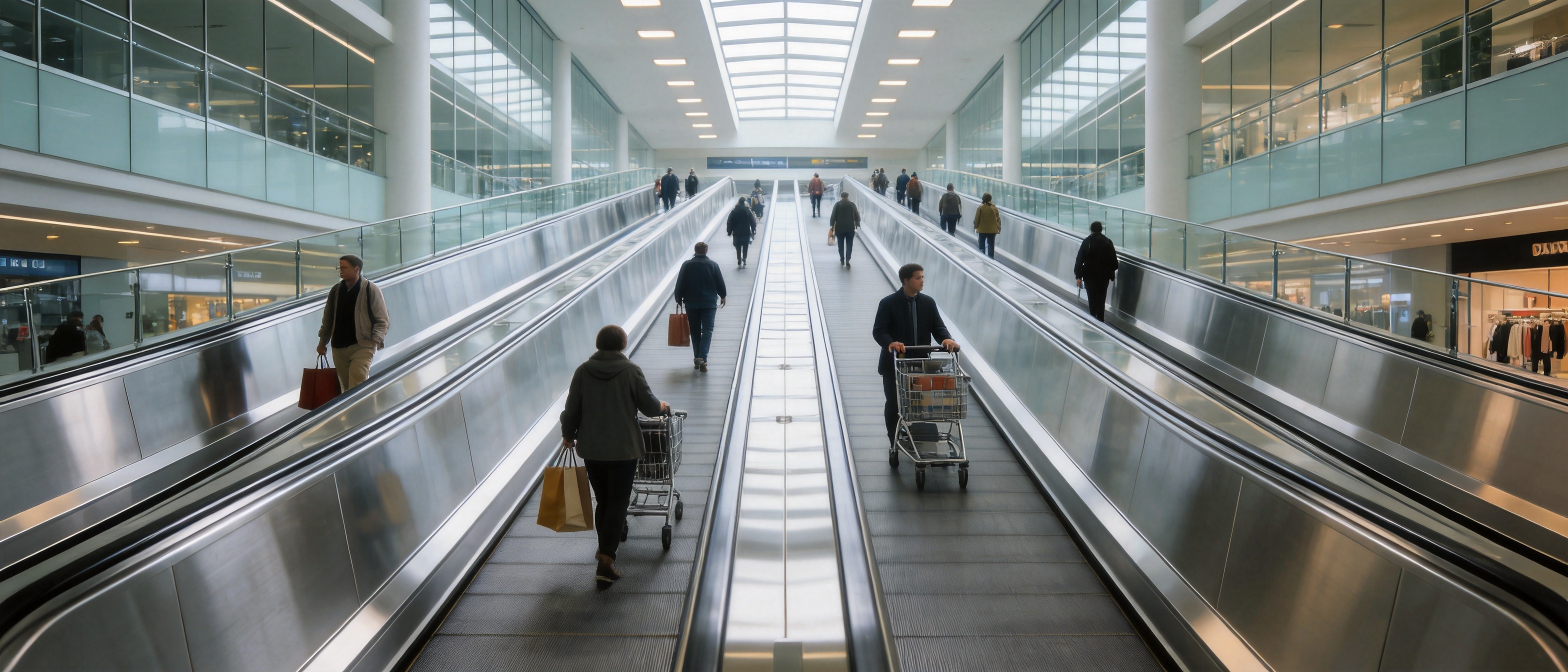
In shopping malls and supermarkets, moving walks improve convenience and commercial circulation. Customers can move between parking lots, retail areas, and supermarket floors while carrying goods or pushing carts. This reduces physical burden and encourages longer visits. For commercial developers, a comfortable moving walk can increase the attractiveness of the building and help guide customer flow strategically.
In airports, moving walks reduce passenger fatigue and improve travel efficiency. Travelers often carry luggage and may need to walk long distances under time pressure. A reliable moving walk helps them move smoothly between terminals, security checkpoints, gates, and baggage areas. Energy-saving operation is also valuable in airports because equipment may run for many hours every day.
In subway stations and railway stations, moving walks support high passenger flow and transfer efficiency. During peak periods, crowd movement must be predictable and safe. Clear direction indication, stable operation, and strong safety protection help reduce congestion and improve passenger confidence.
In hospitals and medical buildings, moving walks can support patients, visitors, and staff who need to travel through large facilities. Smooth movement and good accessibility help reduce fatigue and improve the overall service environment. Safety and reliability are especially important in healthcare settings.
In exhibition centers and large public venues, moving walks help distribute crowds across long halls and connected buildings. They can reduce bottlenecks and improve the visitor experience. A visually modern design also supports the professional image of the venue.
15. Environmental and Economic Value
Sustainability is becoming increasingly important in building design and facility management. Moving walkways contribute to environmental goals when they use energy-efficient drives, intelligent operation modes, durable materials, and maintenance systems that extend service life. The product’s variable frequency control and automatic sensed starting and braking technology directly support energy reduction.
Energy savings of up to 40 percent under appropriate conditions can help reduce operating costs and environmental impact. For large buildings with several units, the savings can be significant over the equipment’s life cycle. Lower energy usage also supports green building objectives and corporate sustainability commitments.
Durability is another environmental advantage. Products with longer service lives reduce the frequency of major replacements and lower material waste. Automatic lubrication, strong structural design, efficient traction machines, and reliable components all contribute to longer life and more sustainable operation.
Economic value comes from several sources: reduced electricity consumption, lower maintenance burden, fewer service interruptions, improved passenger flow, and enhanced building image. In commercial spaces, better passenger circulation may also support stronger retail performance. In transportation facilities, reliable movement supports operational efficiency and passenger satisfaction.
16. Why Manufacturing Strength Matters for Project Owners
When selecting a moving walkway supplier, project owners should look beyond catalog specifications. The real question is whether the manufacturer can deliver stable quality at scale, provide technical support, respond to issues, and maintain product performance over time. Manufacturing strength directly affects all of these outcomes.
A company with advanced processing equipment can achieve better consistency. A company with intelligent detection can identify defects earlier. A company with established production lines can manage delivery schedules more reliably. A company with international service experience can communicate more effectively with overseas customers. These capabilities reduce project risk.
The described manufacturer benefits from integrated production resources, experienced employees, intelligent manufacturing concepts, and strict inspection systems. Its background in elevator and escalator production provides technical depth. Its overseas market orientation improves its ability to understand international customer requirements. Together, these strengths help the moving walk product compete strongly against ordinary suppliers.
For contractors, choosing a capable manufacturer can simplify coordination. Technical drawings, installation guidance, documentation, packaging, shipment, and after-sales communication all require professional management. For developers and owners, a reliable manufacturer supports long-term building performance. For passengers, the result is simple: a safer, smoother, and more comfortable ride.
17. Q&A Section
Q1: What types of buildings are most suitable for this moving walkway?
This moving walkway is suitable for shopping malls, supermarkets, airports, railway stations, subway stations, pedestrian bridges, hospitals, exhibition centers, commercial complexes, and large public buildings. It is especially valuable in places with large passenger flow, long walking distances, or frequent use of luggage carts, shopping carts, baby strollers, and mobility aids.
Q2: How does the product help save energy?
The product can use variable frequency driving and automatic sensed starting and braking technology. When no passenger is present, the moving walk can operate at a lower speed. When a passenger approaches, it returns to normal speed. This intelligent operating mode can reduce unnecessary energy consumption and may save up to 40 percent of power under suitable conditions.
Q3: What safety features make the moving walk reliable for public use?
Safety features include warning lines, passenger illumination, handrail inlet protection, running direction indication, failure display, emergency braking options, and comprehensive system monitoring. These functions help guide passengers, improve visibility at entrances and exits, support rapid troubleshooting, and reduce operational risks.
Q4: Why is the trouble indicator important?
The trouble indicator accurately displays the location of a fault, allowing maintenance personnel to find and solve problems more quickly. This reduces downtime, improves maintenance efficiency, and helps keep passenger flow stable in busy buildings.
Q5: What is the advantage of automatic lubrication?
Automatic lubrication helps protect chains and transmission components by applying lubrication according to preset operating intervals. This reduces manual maintenance uncertainty, lowers wear, improves running smoothness, and extends component service life.
Q6: How does the product compare with low-cost moving walkways?
Low-cost moving walkways may reduce initial investment but often create higher long-term costs through greater energy consumption, more frequent maintenance, weaker safety design, higher noise, and shorter component life. This product focuses on life-cycle value through energy efficiency, durable structure, intelligent control, refined design, and strong manufacturer support.
Q7: Can the moving walkway be customized for different buildings?
Yes. The product can support different arrangement plans, handrail and fencing options, operating modes, and optional functions. Layouts can be planned according to passenger flow, building space, traffic direction, and commercial strategy.
Q8: What manufacturing strengths support the product’s quality?
The manufacturer uses professional elevator and escalator production lines, automatic panel production equipment, intelligent processing concepts, strict inspection systems, and experienced technical teams. These strengths improve precision, consistency, appearance quality, and long-term reliability.
Q9: Why is after-sales service important for moving walkways?
A moving walkway is a long-term transportation system that requires regular maintenance. Strong after-sales service helps ensure safety, stable performance, fast troubleshooting, and longer product life. Service standards, customer files, remote monitoring concepts, and full-time response all contribute to better operation.
Q10: What are the main benefits for passengers?
Passengers benefit from smoother movement, reduced walking fatigue, safer entry and exit areas, clear guidance, quieter operation, and easier travel with luggage, carts, strollers, or mobility aids. The result is a more comfortable and inclusive mobility experience.
18. Conclusion
A moving walkway is a vital mobility solution for modern buildings that need to manage large passenger flows, long travel distances, and diverse user needs. The product described here combines smooth operation, safety protection, energy-saving control, intelligent maintenance, durable structure, and attractive design. It is not only a transportation device but also a contributor to building efficiency, commercial value, and passenger comfort.
Its advantages over ordinary competitors come from integrated engineering rather than isolated features. Variable frequency control reduces energy consumption. Fault indication improves maintenance response. Automatic lubrication extends service life. Strong truss design supports stability. Passenger illumination and direction indicators improve safety. Aesthetic customization helps the equipment fit modern spaces. Together, these qualities create a moving walk that performs reliably and looks appropriate in high-value public environments.
Tenau Elevator (China) Co., Ltd. strengthens the product with advanced manufacturing processes, intelligent production concepts, strict quality control, international service experience, and a customer-oriented philosophy. For project owners, architects, contractors, and facility managers, this combination provides practical confidence. A well-engineered moving walkway can reduce operating costs, improve passenger satisfaction, support sustainable building operation, and enhance the image of the entire facility.
As cities, transport systems, and commercial buildings continue to grow, the need for safe, efficient, and comfortable passenger movement will become even more important. A high-quality moving walk is a forward-looking investment in accessibility, operational performance, and public convenience.
References
1. Elevator and Escalator Engineering Handbook, technical guidance on passenger transportation systems and safety principles.
2. ISO 25745, Energy Performance of Lifts, Escalators and Moving Walks.
3. EN 115, Safety of Escalators and Moving Walks.
4. ASME A17.1/CSA B44, Safety Code for Elevators and Escalators.
5. CIBSE Guide D, Transportation Systems in Buildings.
6. Modern Building Transportation Planning Studies, passenger flow and vertical-horizontal mobility analysis.

Related Products
Related News
Built on safety, forging trust in vertical mobility.
lf you have any questions or need help, feel free to contact with our team.
 export@tenau.com.cn
 +86-18601458867
 +86-512-65059883
Elevator & Escalator
Factory Add
East of Xicheng Road, North of Lianyi Road, Nanxun Economic Development Zone, Nanxun District, Huzhou City, Zhejiang Province, P.R.China
Copyright © Tenau Elevator (China) Co., Ltd. All Rightd Reserved.
Custom High Quality Elevator Suppliers and World Brand Elevator Company