

 en
en Español
 русский
 中文简体
中文简体
Machine Room Less Home Elevator for Safer, Quieter, and Smarter Living
Content
- 1 Why Machine Room Less Design Matters in a Home Elevator
- 2 Comfort Designed for Families and Elderly Users
- 3 Intelligent Control and Radiation-Free Cabinet Design
- 4 Safety Protection as a Core Value
- 5 Travel Functions That Improve Daily Use
- 6 Flexible Application and Aesthetic Integration
- 7 Key Advantages at a Glance
- 8 Advanced Manufacturing Strength Behind the Product
- 9 Industry 4.0 and Intelligent Production Benefits
- 10 Service System and Optional Internet of Things Monitoring
- 11 Comparison with Conventional Residential Elevator Solutions
- 12 Suitable Applications
- 13 Important Functional Details
- 14 Why Manufacturer Capability Matters When Choosing a Home Elevator
- 15 Q&A: Common Questions About the Machine Room Less Home Elevator
- 15.1 Q1: What is the main advantage of a machine room less home elevator?
- 15.2 Q2: Is the elevator suitable for elderly family members?
- 15.3 Q3: How quiet is the elevator during operation?
- 15.4 Q4: What happens if there is a power failure?
- 15.5 Q5: Does the elevator include emergency communication?
- 15.6 Q6: Can the elevator match different home interiors?
- 15.7 Q7: How does the product handle electromagnetic radiation concerns?
- 15.8 Q8: What makes the manufacturer competitive?
- 15.9 Q9: Is remote monitoring available?
- 15.10 Q10: Why choose this product instead of a basic residential lift?
- 16 Conclusion
- 17 References
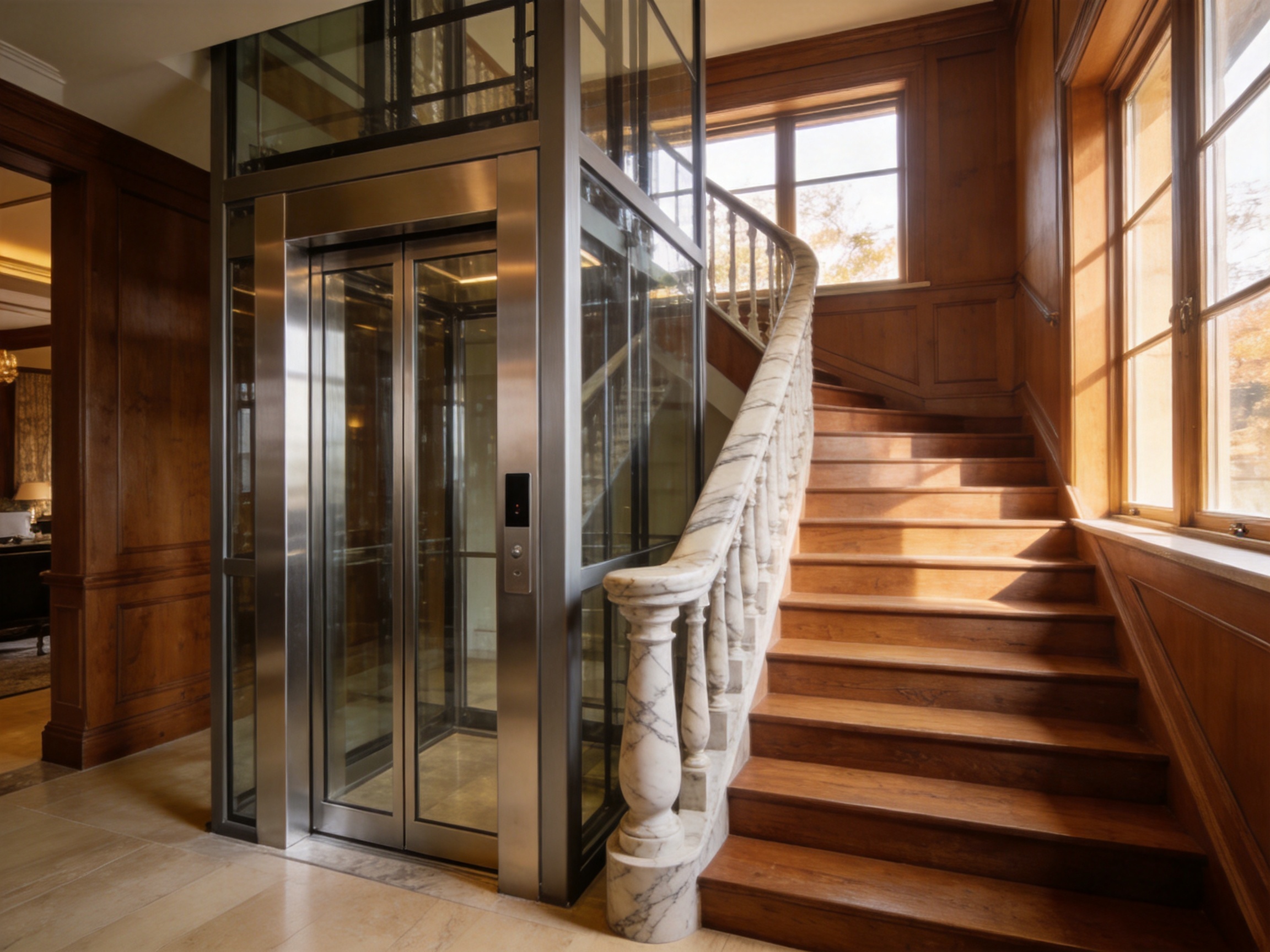
A home elevator is no longer viewed only as a luxury feature for large villas or high-end residences. In modern residential design, it has become a practical mobility solution, a comfort upgrade, and a long-term investment in accessibility. As families plan homes for multiple generations, the demand for compact, quiet, safe, and energy-efficient vertical transportation continues to rise. A machine room less home elevator answers this demand by combining space-saving engineering with intelligent control, smooth operation, and comprehensive protection functions.
The Home Elevator offered by Tenau Elevator (China) Co., Ltd. belongs to the machine room less elevator category. Its design concept focuses on building a happy and harmonious home life through intensive machine roomless architecture, an “electric home appliance style” energy-saving idea, all-round safety protection, environmentally friendly drive technology, and comfortable start and stop performance. For private residences, townhouses, villas, and multi-level family buildings, this type of elevator provides a practical balance between compact installation, dependable safety, elegant appearance, and user-friendly operation.
Compared with many conventional residential elevators, the machine room less home elevator eliminates the need for a separate machine room, helping architects and homeowners preserve valuable building space. This is especially important in modern homes where every square meter matters. Instead of requiring an additional equipment room above or beside the shaft, the system integrates key components into a compact arrangement. The result is a cleaner architectural layout, more flexible space planning, and easier adaptation to new or existing residential structures.
Another important advantage is the product’s focus on family-oriented comfort. Residential elevator users often include children, elderly people, and individuals with mobility challenges. For these users, ride smoothness, low noise, clear control, reliable leveling, and emergency protection are not secondary features; they are central requirements. This home elevator is designed with a smooth running system, comfortable speed curve, soft start and stop performance, and noise-reducing technologies that help keep operational noise below 43 dB. In a home environment, this quiet performance helps protect sleep, conversation, and daily comfort.
Tenau Elevator (China) Co., Ltd. supports this product with professional manufacturing capability and export-oriented service experience. Located in Huzhou City, Zhejiang Province, the company benefits from proximity to Shanghai and operates within an industrial environment built for efficient production and international cooperation. The company is associated with professional elevator and escalator production lines, automatic panel production equipment, and an industrial production philosophy that emphasizes high standards, high precision, and zero-defect ambition. These strengths help the company provide reliable elevator solutions to customers from many regions and application backgrounds.
Why Machine Room Less Design Matters in a Home Elevator
The machine room less concept is one of the most valuable innovations for residential elevators. Traditional elevator designs often require a dedicated machine room, which can increase construction cost, occupy additional space, complicate roof design, and limit architectural freedom. In private homes, where the building footprint is usually smaller than commercial properties, these disadvantages become more noticeable. A machine room less home elevator addresses these concerns by using an intensive design that saves space and simplifies the building layout.
For homeowners, the benefit is immediate: more usable area remains available for living, storage, decoration, or structural planning. For architects, the elevator becomes easier to integrate into the overall building concept. The system can better adapt to stairwells, central residential cores, side shafts, and customized layouts. Because the product is designed to meet the aesthetics of residential buildings, it supports a wider range of interior combinations and car decoration options. This flexibility helps homeowners select an elevator that feels like part of the home rather than an industrial machine inserted into a domestic environment.
The machine room less structure also reflects a modern “electric home appliance style” energy-saving idea. The elevator is expected to behave more like a reliable household appliance: compact, efficient, convenient, safe, and unobtrusive. In a home, equipment should not disturb daily life. It should work quietly, consume energy responsibly, and require reasonable maintenance attention. This design philosophy is especially suitable for private users who want a comfortable lifestyle upgrade without excessive technical complexity.
Competitor products may provide basic vertical movement, but not all of them combine compact structural design with low-noise performance, intelligent control, emergency self-rescue functions, and service support. Some residential elevators may still require more building space, produce more vibration, or offer limited emergency functions. The Home Elevator’s advantage lies in its combined system approach: space saving, family safety, ride comfort, radiation shielding, interference resistance, and optional Internet of Things service support are considered together.
Comfort Designed for Families and Elderly Users
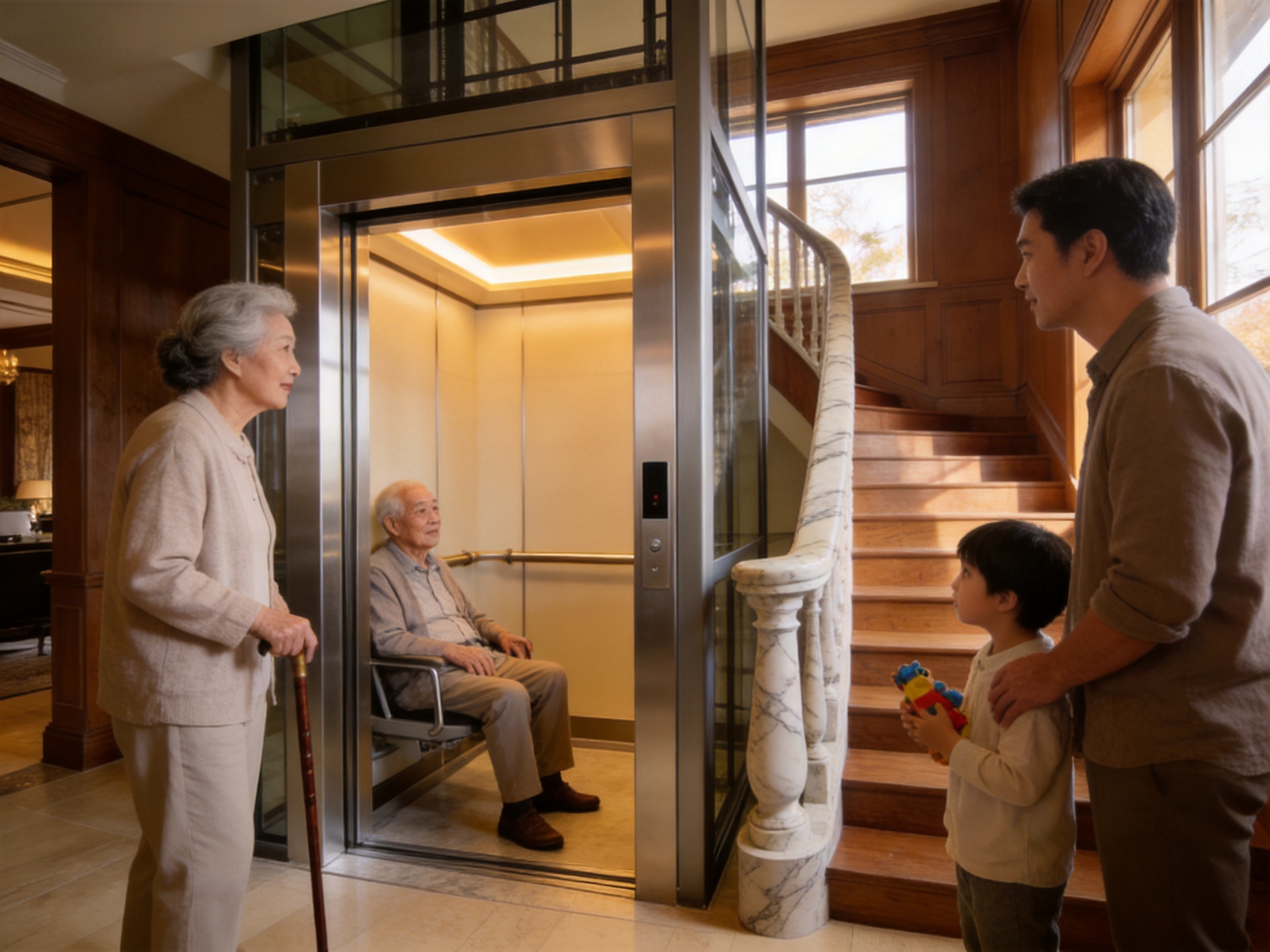
A home elevator must feel different from a public commercial elevator. In a shopping mall or office building, passengers may tolerate moderate noise or brisk acceleration because the ride is brief and functional. In a private residence, however, the elevator becomes part of daily living. It may be used early in the morning, late at night, during rest periods, or by elderly family members who are sensitive to sudden movement. Therefore, comfort is a major product advantage.
This home elevator uses a running system specially designed with elderly users in mind. The speed curve is optimized to provide smooth acceleration and deceleration, while start and stop movements are soft and stable. This reduces the sense of shaking, sudden pull, or uncomfortable transition that can occur in less refined elevator systems. For older people, smooth leveling and gentle movement can support confidence and independence. For children, it creates a calmer and safer riding experience. For all family members, it makes daily vertical movement feel natural.
Noise control is another decisive factor. The product combines low-noise traction machine design, car wall triple noise-reducing technologies, and running system noise-reducing design. With operating noise controlled below 43 dB, the elevator is suitable for household environments where quietness matters. In practical terms, this means the elevator can operate without significantly affecting family sleep, study, work-from-home activities, or relaxation. This advantage is especially valuable in villas and multi-floor homes where elevator shafts may be near bedrooms, living rooms, or private study areas.
Compared with competitors that focus mainly on installation convenience or decorative style, this home elevator places equal emphasis on acoustic comfort and ride quality. A beautiful elevator that produces excessive noise or unpleasant vibration will not satisfy users over the long term. By combining mechanical design, car structure, and running control, the product addresses the details that determine daily satisfaction.
Intelligent Control and Radiation-Free Cabinet Design
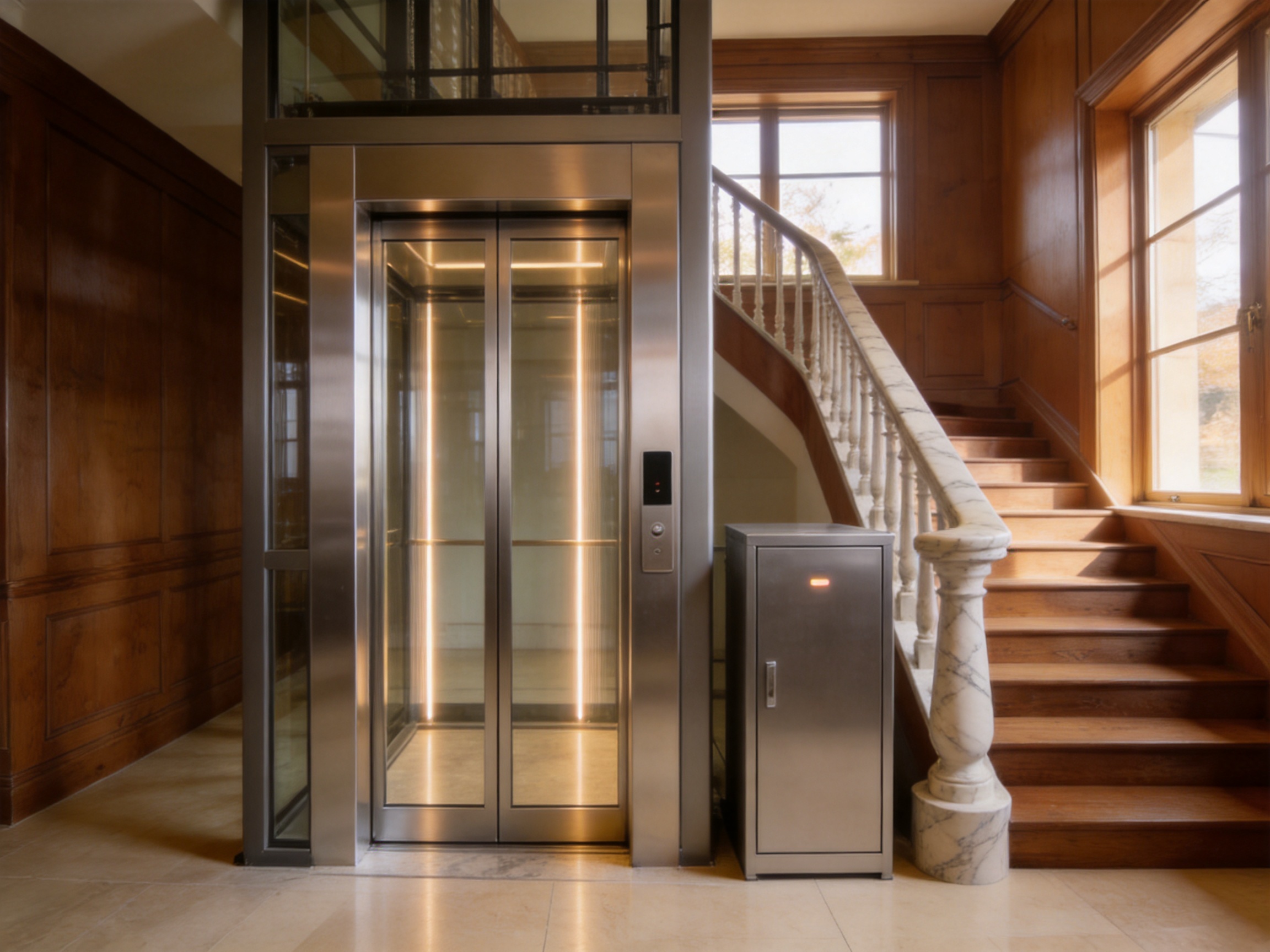
The elevator applies an integrated control cabinet that combines modern industrial control technology with communication technology. One notable feature is its all-steel plate enclosed design, which helps shield radiation. In a private home, users may have concerns about electromagnetic radiation, interference with household appliances, or the effect of equipment operation on communication devices. The product’s control design responds to these concerns by emphasizing radiation-free and interference-resistant operation.
The system is described as not affecting normal use of mobile phones, household appliances, and other electrical devices. At the same time, it strongly resists interference from other home appliances. This is important because modern residences contain many electronic systems: Wi-Fi equipment, televisions, refrigerators, air conditioners, smart home controllers, security systems, computers, and charging devices. An elevator installed in such an environment should operate safely without being disturbed by nearby electrical equipment and without disturbing the home’s electronics.
The door machine system uses variable voltage and variable frequency control technology, allowing the door running curve to be adjusted freely. This contributes to safer and more stable door operation. Door performance is a key element of elevator safety because many passenger interactions occur at the entrance. Smooth opening and closing, light curtain protection, adjustable door open time, and misuse protection all reduce risk and improve user convenience. For families with children or elderly users, a stable and responsive door system is especially important.
Many residential elevator competitors offer basic button control and door operation, but fewer emphasize integrated shielding, communication technology, door curve adjustment, and convenient maintenance in one system. The intelligent control design supports long-term reliability and easier service. For homeowners, this means the elevator is not simply a mechanical lifting device; it is a controlled mobility system designed for modern residential electrical environments.
Safety Protection as a Core Value
Safety is the foundation of every elevator product, but in a home elevator, safety has a personal emotional dimension. The passengers are family members, guests, elderly parents, children, and people who may need assistance. A residential elevator must therefore provide both technical protection and psychological reassurance. This Home Elevator includes multiple safety functions intended to protect users during normal operation, abnormal conditions, and emergency situations.
The safety system includes fault detection and rescue, motor overheat protection, automatic fault diagnosis, inverter overheat protection, overcurrent protection, overload protection, anti-reverse protection, slip protection, overrun protection, main circuit fault protection, door block protection, entrance light curtain protection, safety circuit protection, change landing floor function, automatic adjustment after power recovery, emergency landing rescue, rescue by telephone call, and running times counting. These functions cover mechanical, electrical, control, and passenger-interaction risks.
Automatic fault diagnosis is especially important because it helps identify abnormal conditions quickly. Instead of waiting for a visible failure, the system can detect problems and support protective action. Motor and inverter overheat protection help safeguard critical drive components. Overload protection prevents operation beyond safe capacity. Door block and light curtain protection reduce the risk of passenger contact with moving doors. Safety circuit protection supports the integrity of core safety logic.
The elevator also includes trouble self-rescue and power-failure self-rescue systems. If something goes wrong, the elevator can rapidly initiate protective behavior and move to a safe floor. If a sudden power failure occurs, the system can automatically start its prepared power source and enable safe leveling so passengers can leave the elevator. In a private home, this feature is extremely valuable because users may not have professional building management personnel nearby. The ability to reach a safe landing during an outage directly improves user confidence.
Emergency calling is another important function. If an emergency occurs, the elevator-operated calling button can connect with an outside telephone, allowing family members to seek support through voice communication. This function is meaningful for elderly users who may ride alone. It also adds another layer of reassurance when the elevator is used by children, guests, or individuals with limited mobility.
Travel Functions That Improve Daily Use
Travel functions determine how convenient and intuitive the elevator feels in everyday operation. A technically safe elevator may still be frustrating if the cabin is poorly lit, the floor display is unclear, the door timing is inconvenient, or the ride sequence feels unnatural. This home elevator includes a broad group of travel, information, and comfort functions that make operation easier for family users.
The cabin includes illumination and ventilation to support comfort during each ride. Arrival indication, running direction display, car position display, floor number display, registered call indication, overload warning, and fault warning provide clear information to users. These features help passengers understand what the elevator is doing, where it is going, and whether any attention is needed. Clear information is especially useful for elderly passengers and guests who may not be familiar with the system.
Door open and door close buttons provide direct control. Automatic door opening and adjustable door open time allow convenient entry and exit. Misuse protection and cancel call by double click help reduce accidental operation. The system can also support calling for the other direction, optimized speed curve, background music or voice announcement as optional functions, and handicapped functions such as braille buttons and voice announcement. Through door control, selective landing floor, and handicapped door open protection may also be available depending on configuration.
These functions create a more complete residential mobility experience. Competitors may offer a simpler control set, but a family elevator should accommodate different age groups, different levels of physical ability, and different daily habits. The availability of accessibility features also supports future-proofing. A home designed today may need to support aging family members tomorrow. Adding functions such as braille buttons, voice announcement, and handicapped door protection helps the elevator remain useful as family needs change.
Flexible Application and Aesthetic Integration
A residential elevator must satisfy both engineering and interior design requirements. Unlike industrial freight elevators or public transit elevators, a home elevator is visible in a personal living space. It should match the style of the residence, whether the home is modern, classical, minimalist, luxurious, or warm and family-oriented. The Home Elevator’s flexible application concept supports building aesthetics and offers rich car combinations to satisfy diverse user requirements.
The machine room less structure saves space and creates more freedom for architects and owners. The shaft and cabin can be planned to coordinate with stairs, hallways, living areas, and private floors. In a new home, this gives designers more options. In an existing building renovation, compact design can reduce the challenge of finding suitable installation space. The product is therefore suitable for both planned construction and lifestyle upgrades in existing residences, depending on site conditions.
Interior flexibility is also a competitive advantage. Some elevator products are functional but visually rigid, forcing the homeowner to adapt the home to the elevator. A better residential solution allows the elevator to adapt to the home. With multiple cabin combinations and design options, the elevator can become an elegant part of the interior rather than a compromise. This supports a higher level of satisfaction because users interact with the elevator visually as well as functionally every day.
Key Advantages at a Glance
| Feature Area | Product Capability | Value for Homeowners | Competitive Advantage |
|---|---|---|---|
| Space Efficiency | Machine room less intensive design | Saves building space and improves layout freedom | More suitable for compact homes than traditional machine room systems |
| Ride Comfort | Optimized speed curve with soft start and stop | Comfortable for elderly users, children, and daily family use | Better residential experience than basic lift systems |
| Noise Control | Low-noise traction machine, car wall noise reduction, running system noise reduction | Operating noise below 43 dB helps protect rest and sleep | Stronger fit for quiet home environments |
| Safety | Fault diagnosis, overload protection, light curtain, emergency rescue, power-failure leveling | Protects users in normal and abnormal conditions | More complete family safety package |
| Intelligent Control | Integrated control cabinet and adjustable door machine curve | Stable operation and convenient maintenance | Combines control precision with household usability |
| Radiation and Interference Protection | Steel enclosed radiation-shielding cabinet | Supports safe coexistence with household electronics | Addresses modern smart-home concerns |
| Design Flexibility | Rich cabin combinations and adaptable layout | Matches different residential interiors | More decorative freedom than rigid standard products |
| Service Support | Full-course tracking service and optional IoT monitoring | Faster response and long-term reassurance | Stronger service ecosystem for overseas customers |
Advanced Manufacturing Strength Behind the Product
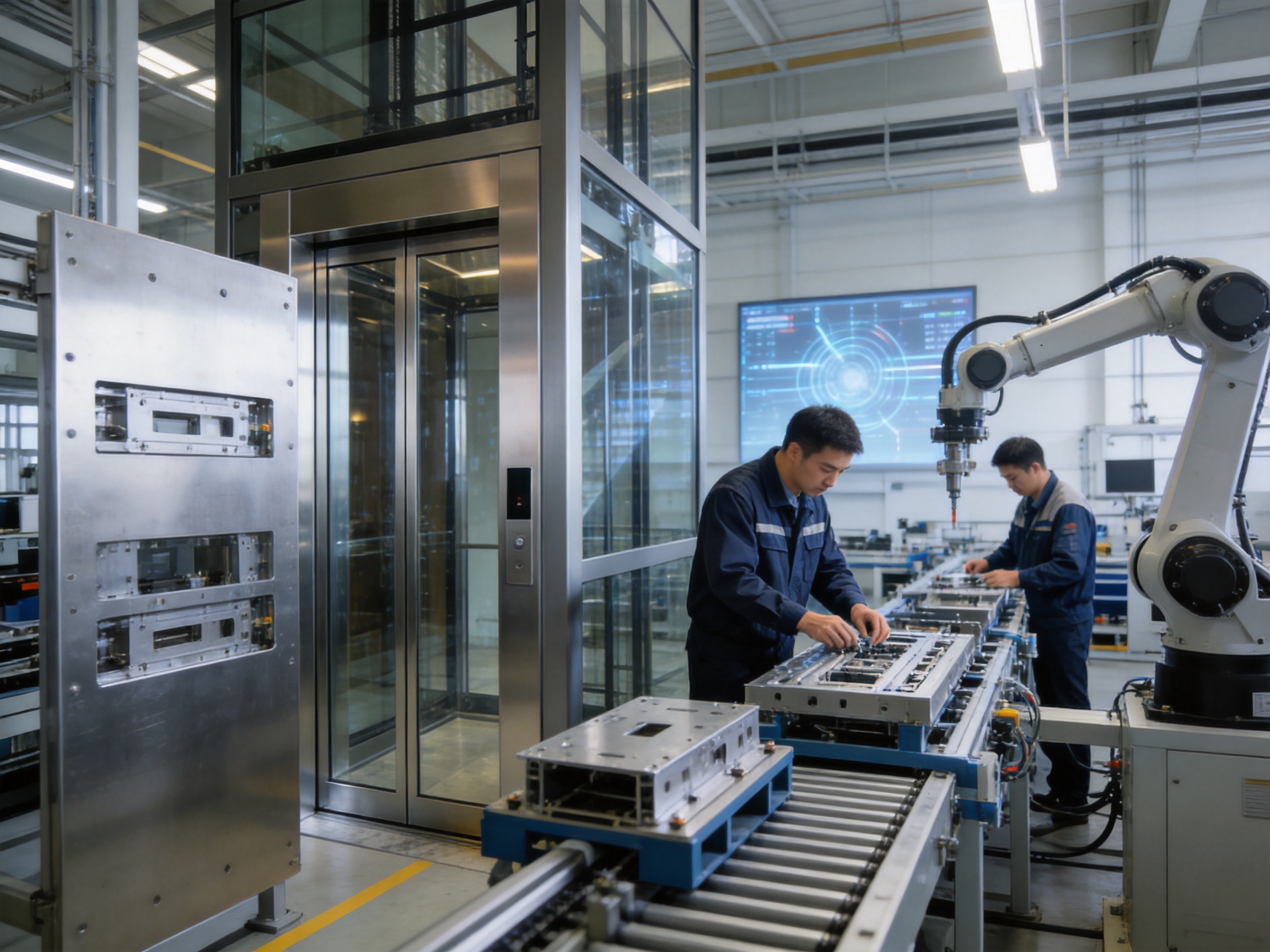
A high-quality home elevator depends not only on design, but also on manufacturing discipline. Elevator components must be produced with precision, assembled consistently, inspected rigorously, and supported by a reliable quality system. Tenau Elevator (China) Co., Ltd. operates as a professional elevator and escalator manufacturing enterprise with an export market orientation. The company has production capabilities that include professional elevator and escalator lines, automatic panel production equipment, and an intelligent production base concept built around efficiency, quality, and green operation.
The company’s industrial system reflects modern manufacturing principles. Its production base integrates design aesthetics, efficient operation, and environmental consideration. The Tenau industry 4.0 production system is described as applying advanced planning and construction ideas, combining automatic production equipment with big data and Internet of Things technologies. Such a system can support intelligent processing, intelligent production, intelligent detection, and intelligent monitoring of industrial procedures. For elevator buyers, this matters because consistent production is essential to safety and long-term reliability.
Automatic production equipment can improve dimensional accuracy, reduce manual variation, and increase repeatability. In elevator manufacturing, panels, doors, structural parts, and control cabinet assemblies must meet strict tolerances. Even small inconsistencies can influence ride quality, door performance, noise, or installation efficiency. By investing in automated equipment and intelligent monitoring, the company strengthens its ability to deliver stable products across different orders and markets.
Quality control is another major strength. The company emphasizes a strategic objective of high standard, high precision, and zero defect. Its working philosophy includes honesty, practicality, perseverance, teamwork, and the pursuit of excellence. The production culture is associated with rigorous detection throughout the whole process, helping ensure that quality is not checked only at the end but managed during production. This approach is important because elevator quality must be built into every stage: design, material preparation, component processing, assembly, testing, packaging, and after-sales support.
For overseas customers, manufacturing strength also includes communication and service capability. The company provides multilingual service, including English, Russian, Spanish, and Arabic. It has experience serving clients from nearly 60 countries, which helps it understand different standards, installation conditions, climate environments, user preferences, and documentation needs. A home elevator for an overseas residence may require customization, careful packaging, professional technical communication, and responsive support. The company’s export-oriented background gives it an advantage over suppliers with limited international experience.
Industry 4.0 and Intelligent Production Benefits
Industry 4.0 manufacturing is not merely a marketing phrase; when applied properly, it can improve product consistency, traceability, and production efficiency. In elevator production, intelligent manufacturing can help monitor process parameters, reduce human error, and support more accurate quality detection. For a machine room less home elevator, the benefit is reflected in the reliability of components, the accuracy of cabin and shaft-related parts, and the stability of control and drive systems.
Intelligent processing helps ensure that metal parts, panels, and structural components are manufactured according to design requirements. Intelligent production supports coordinated assembly and workflow management. Intelligent detection helps identify defects or deviations before products leave the factory. Intelligent monitoring allows production managers to understand process status and improve efficiency. Together, these capabilities support a more dependable supply chain for residential elevator buyers.
Compared with smaller workshops or low-cost competitors that rely heavily on manual production, a manufacturer with advanced production systems can deliver more stable quality. In elevators, consistency matters as much as innovation. A product may have an attractive design, but if production quality varies from unit to unit, users may experience noise, vibration, poor door performance, or service problems. Advanced manufacturing reduces these risks by standardizing key procedures and improving inspection discipline.
Green manufacturing and efficient operation also align with the energy-saving idea of the product itself. A home elevator should support modern living without unnecessary waste. By combining efficient product design with an industrial base that values green environment and intelligent operation, the company presents a complete value chain: responsible production, efficient equipment, and reliable long-term service.
Service System and Optional Internet of Things Monitoring
Elevator ownership does not end after installation. A home elevator must be maintained, monitored, and supported throughout its service life. Tenau emphasizes full-course service and customer care throughout the year. The company’s service philosophy states that good service and a good elevator together create true quality. This is a practical view, because even a well-made elevator requires correct installation guidance, periodic inspection, spare parts support, technical advice, and emergency response capability.
The company offers one-to-one full-course tracking service, aiming to treat customer requirements as a priority. For overseas buyers, this type of service can be particularly valuable. Different countries may have different site conditions, electrical requirements, decoration preferences, and usage habits. Professional communication before, during, and after the order helps reduce misunderstandings and improve project results.
Optional Internet of Things service adds another layer of value. The elevator running condition online monitoring and trouble classification graded long-distance warning system can help connect elevator condition testing, warning, and emergency repair. Through this system, useful information can be captured earlier, allowing service teams to respond more promptly and effectively. In a residential context, early warning and remote condition awareness can reduce downtime and improve peace of mind.
Some competitors may provide only product shipment and basic documentation, leaving customers to solve operational problems locally. A stronger service ecosystem helps distinguish this home elevator solution. The ability to combine equipment manufacturing with monitoring concepts, emergency repair coordination, and customer tracking service creates a more complete ownership experience.
Comparison with Conventional Residential Elevator Solutions
To understand the value of this machine room less home elevator, it is useful to compare it with conventional residential elevator solutions. Traditional elevators with machine rooms may offer proven technology, but they often require additional building space and may restrict architectural design. Hydraulic elevators can be useful in some low-rise applications, but they may require separate equipment space, oil-related maintenance considerations, and may not always provide the same energy-saving image desired by modern homeowners. Basic platform lifts can support accessibility, but may lack the ride comfort, cabin experience, speed curve optimization, and comprehensive safety functions of a full elevator system.
The machine room less home elevator provides a balanced alternative. It saves space while offering a complete cabin elevator experience. It emphasizes low noise and smooth operation, which are crucial for homes. It includes advanced control and safety features, making it more sophisticated than simpler lifting devices. It also supports aesthetic customization, allowing the elevator to match residential interiors.
Another advantage is long-term adaptability. A homeowner may initially install an elevator for convenience, luggage movement, or property value. Over time, the same elevator may become essential for elderly parents, injury recovery, or wheelchair access. A machine room less elevator with optional accessibility functions is better positioned to serve changing family needs. This future-oriented value is often more important than the initial purchase decision suggests.
From a property perspective, a well-integrated home elevator can improve the usability and attractiveness of a multi-floor residence. It can make upper floors more accessible, increase convenience for carrying groceries or household items, and support aging-in-place living. When combined with quiet performance and elegant design, the elevator becomes a lifestyle feature rather than merely a mechanical necessity.
Suitable Applications
This home elevator is especially suitable for private villas, townhouses, duplex apartments, small residential buildings, family houses with elderly residents, and customized luxury homes. It can also be considered for renovation projects where space saving is important, provided that site conditions allow proper shaft construction and installation. Because of its flexible application, it can adapt to a range of building aesthetics and functional needs.
For a villa, the elevator can connect basement garages, ground-floor living spaces, bedroom floors, terraces, or entertainment areas. For a townhouse, it can reduce the burden of stairs and make every level more accessible. For a family with elderly members, it supports independence and reduces the risk associated with stair climbing. For homeowners planning for the future, it adds long-term resilience to the property.
In premium residences, the elevator can also serve as an interior design feature. Rich cabin combinations allow owners to coordinate materials, colors, lighting, and finishes with the broader home style. When the elevator is quiet, smooth, and visually integrated, it enhances the overall living experience without drawing unwanted attention to mechanical operation.
Important Functional Details
The product’s safety functions include fault detection and rescue, motor overheat protection, automatic fault diagnostic function, inverter overheat protection, overcurrent protection, overload protection, anti-reverse protection, slip protection, overrun protection, main circuit fault protection, door block protection, entrance light curtain protection, safety circuit protection, landing floor change, automatic adjustment after power recovery, emergency landing rescue, rescue by telephone call, and running times counting.
Comfort functions include door open and close buttons, light curtain protection, misuse protection, cancel call by double click, call for the other direction, cabin illumination, cabin ventilation, arrival indication, optimized speed curve, and optional background music or voice announcement. Accessibility-related functions may include braille buttons, voice announcement, through-door control, selective landing floor, and handicapped door open protection.
Control functions include automatic door opening, adjustable door open time, inspection operation, test operation, automatic home return, fault memory, and shaft information self-learning. Information functions include landing running direction display, car position display, indication of registered call, fault warning, cabin registered call indication, running direction display, floor number display, overload warning, and fault warning.
These functions show that the elevator is not designed around a single feature. Instead, it is a complete system in which safety, comfort, information, control, and service cooperate. That system-level design is one of its most meaningful advantages over competitors that may emphasize only price, decoration, or basic lifting capability.
Why Manufacturer Capability Matters When Choosing a Home Elevator
Choosing a home elevator is different from buying ordinary household equipment. The product becomes part of the building structure and may serve the family for many years. Safety, maintenance, spare parts, customization, installation support, and technical documentation all matter. Therefore, the manufacturer’s capability should be evaluated as carefully as the elevator’s appearance.
Tenau Elevator (China) Co., Ltd. has a background as a professional elevator and escalator manufacturing enterprise. The company focuses on customized solutions, whether for a single product or complete sets of equipment. It emphasizes timely responses to customer problems, careful feedback handling, professional communication for inquiries, and reasonable pricing. For new customer product needs, the company communicates professionally, listens to customer views, and offers useful development suggestions. This customer-oriented process is valuable for residential elevator projects because each home may have unique requirements.
The company’s production base, intelligent manufacturing system, automatic equipment, and rigorous quality detection provide a foundation for dependable product delivery. Its export experience and multilingual service support international cooperation. Its strategic quality objective and production discipline further reinforce buyer confidence. In a market where some suppliers compete mainly on low price, these manufacturing and service strengths help position the product as a safer and more reliable long-term choice.
Q&A: Common Questions About the Machine Room Less Home Elevator
Q1: What is the main advantage of a machine room less home elevator?
The main advantage is space saving. Because the elevator does not require a separate machine room, it offers more freedom for architectural planning and preserves usable residential space. This makes it especially suitable for villas, townhouses, and compact homes.
Q2: Is the elevator suitable for elderly family members?
Yes. The elevator is designed with a smooth running system, optimized speed curve, and soft start and stop performance. These features make the ride more comfortable and reassuring for elderly users, children, and passengers who are sensitive to sudden movement.
Q3: How quiet is the elevator during operation?
The elevator combines low-noise traction machine design, car wall noise-reducing technologies, and running system noise-reducing design. Operational noise is controlled below 43 dB, helping reduce disturbance to family sleep, rest, study, or work-from-home activities.
Q4: What happens if there is a power failure?
The power-failure self-rescue system can automatically start a prepared power source and support safe leveling, allowing passengers to leave the elevator safely. This is an important safety feature for private homes where professional building staff may not be present.
Q5: Does the elevator include emergency communication?
Yes. The emergency calling system can connect with an outside telephone through the elevator-operated calling button, allowing passengers to seek support through voice communication during an emergency.
Q6: Can the elevator match different home interiors?
Yes. The elevator supports flexible application and rich cabin combinations, allowing it to coordinate with various residential styles. It can be planned to match modern, classical, minimalist, or luxury interior designs.
Q7: How does the product handle electromagnetic radiation concerns?
The integrated control cabinet uses an all-steel plate enclosed design that helps shield radiation. The system is designed not to interfere with normal use of mobile phones and household appliances, while also resisting interference from other electrical devices.
Q8: What makes the manufacturer competitive?
Tenau Elevator (China) Co., Ltd. combines professional elevator manufacturing, automatic production equipment, intelligent production concepts, rigorous quality detection, export experience, and multilingual service. These strengths support stable product quality and international customer cooperation.
Q9: Is remote monitoring available?
Optional Internet of Things monitoring is available. It can support online monitoring of elevator running condition and trouble classification with long-distance warning, helping improve service response and maintenance efficiency.
Q10: Why choose this product instead of a basic residential lift?
This machine room less home elevator offers a more complete combination of space efficiency, cabin comfort, low noise, advanced safety protection, intelligent control, aesthetic flexibility, and service support. It is designed as a long-term residential mobility system rather than a simple lifting device.
Conclusion
The machine room less home elevator represents a modern direction in residential vertical transportation. It saves space, supports flexible building design, operates quietly, provides smooth ride comfort, and protects users through multiple safety systems. Its radiation-shielded integrated control cabinet, variable frequency door machine system, power-failure self-rescue capability, emergency calling function, and optional Internet of Things monitoring make it especially suitable for modern family living.
Beyond the product itself, the manufacturing strength of Tenau Elevator (China) Co., Ltd. adds important value. Advanced production equipment, intelligent manufacturing concepts, rigorous quality detection, export experience, multilingual service, and a customer-oriented philosophy help create confidence for residential buyers and project partners. In a competitive elevator market, the strongest solution is not merely the one with the most attractive cabin or lowest price; it is the one that combines safety, comfort, engineering, manufacturing discipline, and long-term service.
For homeowners seeking a compact, quiet, elegant, and safe vertical mobility solution, this machine room less home elevator offers a practical and future-ready choice. It supports today’s comfort while preparing the home for tomorrow’s accessibility needs. It improves daily life without occupying unnecessary space. It protects family members with intelligent safety systems. Most importantly, it turns vertical movement inside the home into a smooth, reliable, and reassuring experience.
References
Tenau Elevator (China) Co., Ltd. Product Materials: Machine Room Less Home Elevator Technical and Functional Description.
Tenau Elevator (China) Co., Ltd. Company Profile and Manufacturing Capability Overview.
International Organization for Standardization. Elevator and Escalator Safety and Quality Management Principles.
Elevator World. Residential Elevator Design, Safety, and Maintenance Industry Discussions.
European Committee for Standardization. Safety Rules and Accessibility Considerations for Lifts.

Related Products
Related News
Built on safety, forging trust in vertical mobility.
lf you have any questions or need help, feel free to contact with our team.
 export@tenau.com.cn
 +86-18601458867
 +86-512-65059883
Elevator & Escalator
Factory Add
East of Xicheng Road, North of Lianyi Road, Nanxun Economic Development Zone, Nanxun District, Huzhou City, Zhejiang Province, P.R.China
Copyright © Tenau Elevator (China) Co., Ltd. All Rightd Reserved.
Custom High Quality Elevator Suppliers and World Brand Elevator Company