

 en
 Español
 русский
 中文简体

Heavy-Duty Public Traffic Escalator for Subway and Airport Standards
Content
- 1 Introduction
- 2 Designed for High-Intensity Public Transportation
- 3 Principal Technical Configuration
- 4 Space-Efficient Transportation for Complex Buildings
- 5 Reinforced Step Chain and External Roller Arrangement
- 6 High-Capacity Drive and Transmission System
- 7 Safety Features for Public Environments
- 8 Passenger Comfort and Operational Stability
- 9 Energy Efficiency and Lifecycle Value
- 10 Adaptability and Customization
- 11 Advanced Manufacturing Capabilities
- 12 Installation and Project Integration
- 13 Maintenance and Serviceability
- 14 Competitive Advantages
- 15 Applications in Subway and Airport Projects
- 16 Recommended Selection Process
- 17 Frequently Asked Questions
- 17.1 What type of facility is this escalator intended for?
- 17.2 What is the rated speed of the test-tower configuration?
- 17.3 What is the step width?
- 17.4 What travelling height has been demonstrated?
- 17.5 Does the product use a 30-degree or 35-degree inclination?
- 17.6 How does the external roller arrangement help maintenance?
- 17.7 What emergency protection features are included?
- 17.8 Why are four horizontal steps used?
- 17.9 Can the escalator be customized?
- 17.10 Is the escalator suitable for outdoor installation?
- 17.11 What manufacturing strengths support the product?
- 17.12 How should operators maintain the escalator?
- 18 Conclusion
- 19 References
- 20 Product: Heavy Duty Public Traffic Escalator for Subway & Airport Standards
Introduction
Modern transportation infrastructure depends on safe, durable, and efficient systems that can move large numbers of people continuously. Subway stations, airports, railway terminals, shopping complexes, pedestrian bridges, convention centers, and other public facilities all require vertical transportation equipment capable of operating for long hours under demanding conditions. A public traffic escalator must do more than connect two levels. It must manage passenger flow, withstand intensive use, maintain stable performance, and provide dependable protection in both normal and emergency situations.
The heavy-duty public traffic escalator described in this article is designed for demanding public transportation environments. It is an outside-type, heavy-duty escalator intended for applications where passenger volume, operating frequency, and long-term durability are critical. Its design combines a reinforced step chain, high-capacity drive system, external roller arrangement, auxiliary braking, distributed emergency stop switches, and four horizontal steps to create a robust passenger transportation solution.
With a maximum lifting height of 25,000 millimeters in the test-tower configuration, the escalator demonstrates an ability to serve large vertical transportation requirements. Its 1,000-millimeter step width supports practical passenger flow, while the rated speed of 0.65 meters per second provides a balance between transportation efficiency, passenger comfort, and operational control. The system can be adapted for subway stations, airports, public buildings, and other high-traffic facilities that require dependable vertical circulation.
In addition to its mechanical performance, the product benefits from an advanced manufacturing system supported by systematic research and development, automated production lines, intelligent manufacturing methods, quality control procedures, and international management standards. These capabilities help create an escalator solution that competes not only through individual components, but also through coordinated design, production, inspection, installation, and after-sales service.
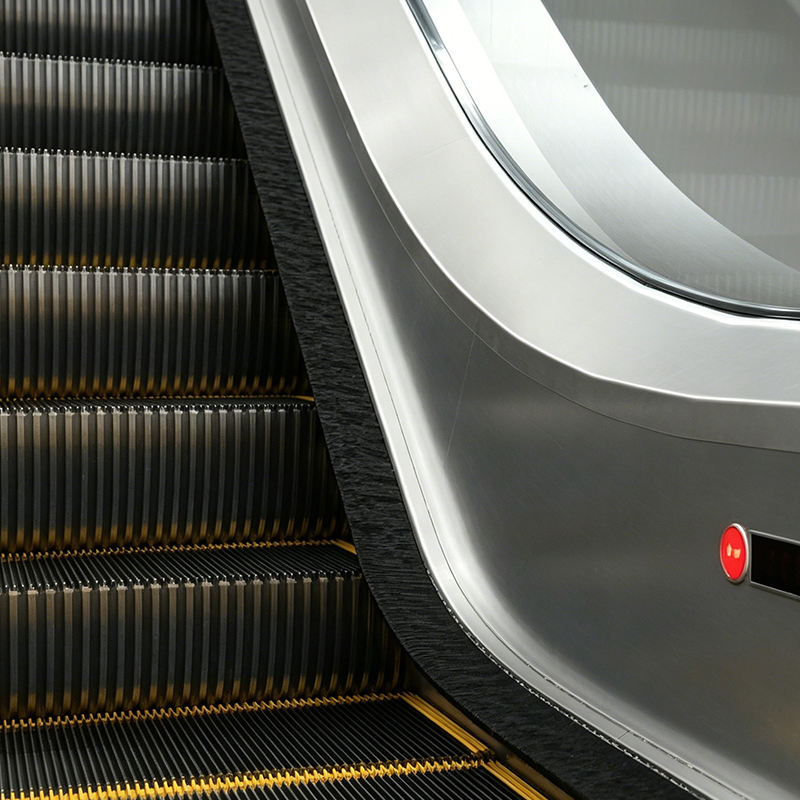
Heavy Duty Public Traffic Escalator for Subway & Airport Standards
Designed for High-Intensity Public Transportation
Public transportation escalators operate under conditions that are considerably more demanding than those found in ordinary commercial or office buildings. Passenger flow may be continuous throughout the day, and the equipment may be exposed to repeated starting, stopping, loading, and environmental changes. Subway and airport installations can also involve long operating hours, large passenger volumes, luggage movement, and strict requirements for service continuity.
The heavy-duty configuration addresses these requirements through structural reinforcement and high-capacity transmission components. It is classified as an outside-type heavy-duty public transportation escalator. This classification reflects its intended application in facilities where reliability and resistance to repeated use are more important than minimal initial equipment cost alone.
The escalator is particularly suitable for locations such as:
• Subway stations with high passenger turnover.
• Airport terminals and airport transportation links.
• Railway stations and intercity transportation hubs.
• Large shopping centers and public entertainment complexes.
• Exhibition halls, convention centers, and stadiums.
• Pedestrian overpasses and underground passageways.
• Large institutional or municipal buildings.
In these environments, the escalator must support a predictable passenger experience. Passengers should be able to step onto the moving steps smoothly, hold the handrail securely, and travel without unnecessary vibration or noise. Operators, meanwhile, need a system that can be inspected, maintained, and repaired without excessive downtime. The product’s design focuses on these two requirements: passenger safety and maintainability.
Principal Technical Configuration
The following specifications describe the escalator installed in the escalator test tower. Actual project parameters may vary according to building design, local codes, site conditions, passenger capacity requirements, and customer specifications.
| Specification | Configuration |
|---|---|
| Type | Outside-type heavy-duty public transportation escalator |
| Maximum travelling height in test-tower configuration | 25,000 mm |
| Horizontal span in test-tower configuration | 51,847 mm |
| Inclined angle | 30° |
| Step width | 1,000 mm |
| Rated speed | 0.65 m/s |
| Quantity of flat steps | 4 |
| Traction machine power | 37 kW × 2 |
| Inverter power | 75 kW |
| Diameter of step main roller | 100 mm |
| Diameter of step secondary roller | 100 mm |
| Handrail drive mode | Sprocket-driven |
The equipment information identifies the test-tower installation as having a 30-degree inclination. The product concept may also be associated with space-saving escalator configurations, including steeper designs for compact buildings. Because inclination, speed, step width, and landing geometry directly affect building layout and regulatory compliance, the final angle should always be confirmed during project engineering.
A 1,000-millimeter step width provides a practical passage area for public facilities. It allows passengers to stand comfortably while leaving room for other passengers to pass when appropriate. This width is also valuable in locations where passengers may carry luggage, shopping bags, backpacks, or other personal items.
The dual 37-kilowatt traction machine arrangement provides substantial drive capacity for the stated heavy-duty configuration. The 75-kilowatt inverter supports controlled operation of the traction system. Together, these components are intended to deliver stable movement and controlled acceleration while supporting the demands of a large public installation.
Space-Efficient Transportation for Complex Buildings
Vertical transportation equipment must fit into the architectural and structural limitations of a project. Subway stations and airport buildings frequently include complex circulation routes, restricted construction zones, underground structures, utility corridors, and limited space for equipment rooms. An escalator must therefore provide sufficient transportation capacity without creating unnecessary demands on the building footprint.
The escalator’s long-span and high-lift capability make it appropriate for projects that require substantial vertical connection. The test-tower configuration demonstrates a 25-meter travelling height and a horizontal span of 51.847 meters. These figures indicate the scale of the equipment and its ability to support major public infrastructure applications.
For compact commercial or office environments, an escalator with a steeper inclination may reduce the required horizontal footprint. The supplied product information refers to a 35-degree space-saving concept for applications where floor area is limited. However, the listed public transportation test configuration uses a 30-degree inclination. This distinction is important: the appropriate configuration must be selected according to passenger traffic, local standards, building geometry, and the intended operating environment.
Project designers can evaluate the following factors when selecting the final layout:
• Available horizontal and vertical space.
• Required passenger capacity.
• Passenger comfort and expected travel duration.
• Local safety regulations and accessibility requirements.
• Integration with stairs, elevators, moving walks, and emergency exits.
• Maintenance access and replacement routes.
• Environmental conditions, including outdoor exposure.
• Required service life and expected daily operating hours.
This design-oriented approach helps prevent the common problem of selecting an escalator based only on nominal speed or step width. A successful installation must be considered as part of a complete transportation network.
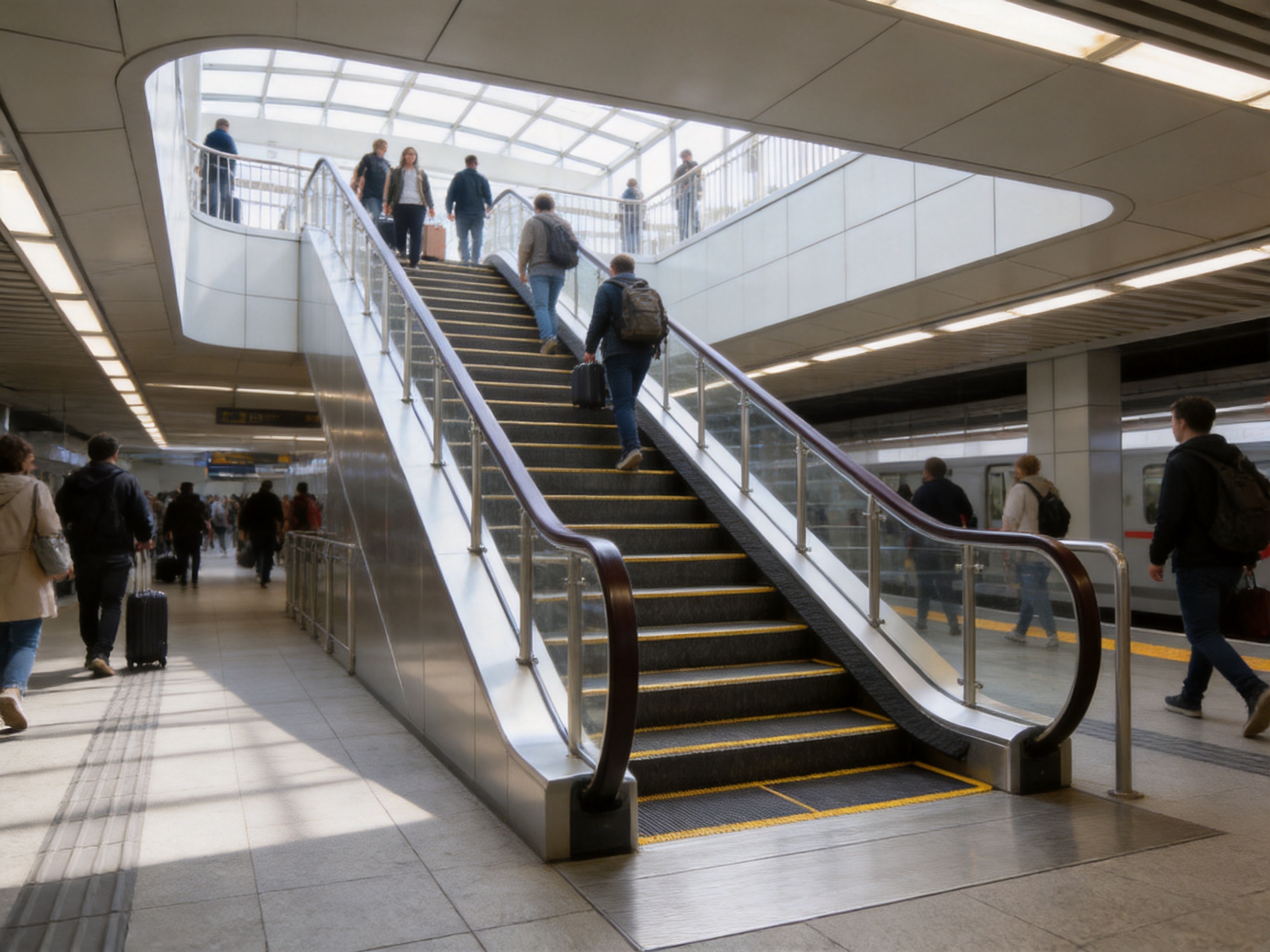
Reinforced Step Chain and External Roller Arrangement
The step chain is one of the most important load-bearing and motion-transmission components in an escalator. It supports the steps and transfers the traction force through the inclined track. In a public transportation installation, the step chain is exposed to repeated tension, bending, rolling contact, vibration, and changing passenger loads. A weak or difficult-to-service chain system can increase maintenance requirements and affect equipment availability.
This escalator uses reinforced materials and structural design in the step chain to increase tensile strength. The arrangement is intended for heavy-duty operation and frequent use. By improving the load-bearing characteristics of the chain and its associated components, the system can better support the repeated operating cycles expected in subway, airport, and other public transportation applications.
A notable feature is that the roller is positioned outside the step chain. Both the main and secondary rollers have a stated diameter of 100 millimeters. The external arrangement helps reduce the compressed load placed on the main wheel and is intended to prolong roller service life. It also allows the roller to be renewed independently, which can simplify maintenance and reduce the time required for component replacement.
Independent roller renewal is valuable to public facility operators. A maintenance team may not need to replace a larger assembly when only a roller has reached the end of its service life. This approach can reduce intervention time, lower replacement costs, and help return the escalator to operation more quickly. In high-traffic transportation facilities, even a small reduction in downtime can provide meaningful operational value.
The 100-millimeter roller diameter also contributes to the overall mechanical design. Larger rollers can provide favorable rolling characteristics and reduce certain forms of concentrated contact stress. Final performance depends on the complete track, bearing, lubrication, alignment, loading, and maintenance system, but the roller configuration demonstrates a clear emphasis on durability and serviceability.
High-Capacity Drive and Transmission System
The drive system is responsible for converting motor power into controlled escalator movement. A public traffic escalator must deliver sufficient torque during loaded operation while maintaining stable speed across the entire travel path. The drive system must also withstand frequent starts and stops, normal passenger load variations, and the mechanical forces generated by a long inclined structure.
The test-tower configuration uses two 37-kilowatt traction machines. This dual-machine arrangement provides a substantial power reserve for the heavy-duty system. The stated inverter capacity is 75 kilowatts, enabling coordinated control of the drive system. Variable-frequency control can support smoother starting and stopping, more accurate speed regulation, and improved energy management when combined with suitable operating controls.
The drive transmission has also been designed to increase driving force and turning space. The turning radius is enlarged to support the transmission movement, while the drive spindle diameter is increased to improve bearing capacity. These modifications are especially relevant to large escalators, where the transmission system must handle significant mechanical loads over extended operating periods.
The handrail drive uses a sprocket-driven mode. The handrail must maintain a synchronized movement relationship with the steps so that passengers can hold it safely while travelling. A dependable handrail drive system can help reduce slippage and support consistent operation. The V-shaped handrail design further increases tensile breaking strength, extends expected service life, enlarges the contact area at the handrail rotary end, and increases friction for effective handrail movement.
These features show that the escalator is designed as an integrated mechanical system. The steps, chain, rollers, traction machines, inverter, spindle, sprocket, and handrail are not independent elements. Their performance depends on correct matching, alignment, manufacturing accuracy, installation, and routine inspection.
Safety Features for Public Environments
Safety is the primary consideration for any escalator installed in a subway, airport, or other public facility. Passenger safety begins with the physical design of the steps and handrails, but it also depends on monitoring systems, emergency stopping devices, braking components, control logic, signage, lighting, and maintenance procedures.
Handrail Speed Monitoring
The handrail must move at an appropriate relationship to the steps. Handrail speed monitoring helps identify abnormal operating conditions and can support protective action if the handrail movement deviates from the expected range. This is particularly important because passengers often rely on the handrail for balance while entering, travelling on, or leaving the escalator.
Step Demarcation
Step demarcation helps passengers identify the boundaries of each step. Clear visual differentiation can improve passenger awareness and reduce the possibility of misplaced feet, especially in crowded areas or under changing lighting conditions. Step demarcation is an important part of the passenger interface and should be coordinated with the overall station or building design.
Emergency Stop Switches
The system includes emergency stop switches at the original upper and lower entry and exit areas. Additional emergency stop switches are positioned at intervals of approximately five meters along the outer cover plate. This distributed arrangement allows an emergency stop command to be initiated from multiple locations along the escalator.
In a busy public environment, an incident may occur away from the landing area. Providing additional emergency stop locations can help passengers, staff, or maintenance personnel respond quickly when an unexpected event is observed. The emergency stop system is intended to stop the escalator rapidly and support passenger protection during sudden situations.
Auxiliary Brake
An auxiliary brake is installed in the upper machine room. It uses a friction-based operating principle, with the brake acting through a wedge and brake disc installed on the drive spindle. The auxiliary braking arrangement provides an additional layer of stopping protection and contributes to the overall safety architecture of the escalator.
Primary and auxiliary braking systems should be inspected according to the applicable maintenance schedule and local regulations. Brake performance depends on correct adjustment, component condition, control-system integration, and professional service. The presence of an auxiliary brake is valuable, but it must function as part of a complete safety management program.
Four Horizontal Steps
The escalator uses four horizontal steps at the transition area. These steps enlarge the buffer distance during passenger entry and exit. A longer horizontal transition gives passengers more opportunity to establish stable footing before the steps begin to rise or descend and before they leave the escalator.
This feature is particularly useful in public facilities where passengers may be distracted, carrying luggage, travelling in groups, or moving through a crowded station. It can also improve the overall perception of smoothness at the landing areas.
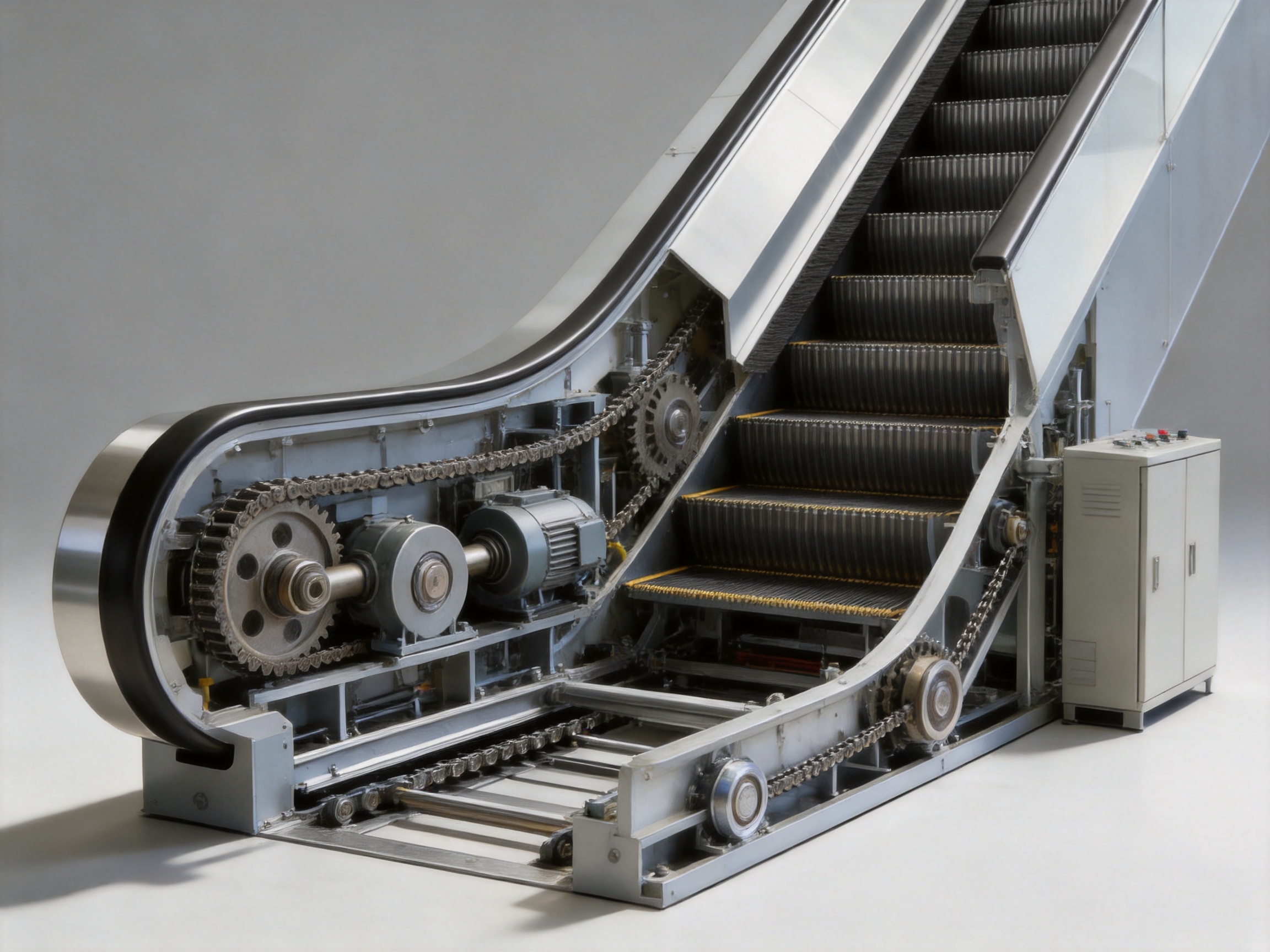
Passenger Comfort and Operational Stability
Heavy-duty equipment should not be judged only by its ability to carry a large load. Passenger comfort is equally important. Excessive vibration, uneven motion, inconsistent handrail speed, or sudden acceleration can create discomfort and reduce passenger confidence. In airports and subway stations, where many users may be unfamiliar with the building, a smooth and predictable journey is essential.
The precision-engineered step chain and drive system are intended to support quiet and stable operation. Accurate manufacturing and correct alignment help minimize unwanted movement. The 0.65-meter-per-second rated speed provides practical passenger throughput while avoiding an unnecessarily aggressive travel experience.
The four horizontal steps at the landings contribute to smoother passenger transition. The V-shaped handrail design supports consistent handrail traction. The reinforced chain and external roller arrangement help maintain mechanical stability. These features work together to create an escalator that is both capable of handling heavy public use and suitable for everyday passenger interaction.
Noise and vibration control also benefit building operators. Reduced mechanical disturbance can improve the surrounding environment, especially in indoor terminals, shopping complexes, and facilities where escalators are located near offices, retail spaces, waiting areas, or passenger service counters.
Energy Efficiency and Lifecycle Value
Large public transportation equipment consumes energy during operation, and energy use can become a significant part of the lifetime operating cost. The product information identifies high-efficiency motors and standby operation as measures that can reduce energy consumption. These features are especially relevant in facilities with variable passenger flow, where the escalator may not need to operate at full capacity continuously.
A high-efficiency motor can reduce electrical losses during normal operation. Standby mode can reduce consumption during periods of low demand, provided that the control strategy is appropriate for the facility. In a subway or airport, standby operation must be coordinated with passenger flow, security requirements, operating schedules, and emergency procedures.
Lifecycle value also includes maintenance, component replacement, energy use, downtime, and expected service life. The external roller arrangement provides a potential maintenance advantage because individual rollers can be renewed independently. Durable components and reinforced transmission parts can help reduce the frequency of major repairs when the equipment is correctly installed and serviced.
Operators should evaluate an escalator by considering total cost of ownership rather than only the initial purchase price. A lower-cost system may become more expensive if it requires frequent shutdowns, difficult component replacement, or high energy consumption. A heavy-duty escalator with strong maintenance access and reliable component design can provide better long-term value in high-use installations.
Adaptability and Customization
Public transportation projects often have different architectural requirements. An airport may require a modern, clean appearance that matches terminal interiors. A subway station may prioritize durability and easy cleaning. A shopping complex may require custom handrail colors and side panels that coordinate with interior decoration. Outdoor installations may require additional attention to weather exposure, drainage, corrosion protection, and local environmental conditions.
The escalator can be customized through options such as step finishes, handrail colors, and side panel materials. These options allow the equipment to become part of the building’s design rather than appearing as an isolated mechanical element.
Customization may also involve:
• Step width and project-specific geometry.
• Inclination according to layout and applicable standards.
• Balustrade and side panel finishes.
• Handrail color and material selection.
• Control and monitoring interfaces.
• Lighting and visual guidance elements.
• Outdoor protection and corrosion-resistant treatments.
• Maintenance access arrangements.
• Integration with building management and emergency systems.
Every customization should be reviewed by the project engineering team. Appearance-related changes must not compromise safety clearances, inspection access, structural strength, electrical protection, or compliance with local codes.
Advanced Manufacturing Capabilities
The performance of a heavy-duty escalator depends heavily on how its components are designed, produced, assembled, inspected, and tested. Advanced manufacturing is therefore not limited to the use of modern machinery. It includes engineering standards, process control, material traceability, production planning, quality inspection, data management, and continuous improvement.
The manufacturer described in the supplied information operates a large-scale production base and integrates design, research and development, manufacturing, marketing, installation, and after-sales service. This integrated structure allows project requirements to be communicated across different stages of the product lifecycle.
The company applies German Industry 4.0 intelligent manufacturing concepts, automated production lines, big data, Internet of Things technology, and a full closed-loop quality control system. These capabilities can support several important manufacturing objectives:
• Improving consistency across repeated components.
• Monitoring production data and process conditions.
• Reducing manual variation in critical manufacturing steps.
• Supporting traceability from raw materials to finished equipment.
• Identifying process deviations before final assembly.
• Coordinating production planning with project delivery schedules.
• Supporting data-based maintenance and quality improvement.
Industry 4.0 methods are especially valuable for escalators because the equipment contains many interacting mechanical, electrical, and structural components. A small variation in a track component, roller, step chain, handrail drive, or drive assembly can influence the performance of the complete system. Automated and digitally monitored processes can help improve repeatability and support more reliable final assembly.
Research and Development
The manufacturer has capabilities in the design and development of low-speed, medium-speed, high-speed, and ultra-high-speed elevators, as well as escalators, moving walks, and related transportation products. Experience across multiple vertical transportation categories can support the development of shared technologies in controls, drive systems, safety devices, manufacturing, inspection, and service.
Research and development also allows the company to adapt products to different building types and regional requirements. Public transportation projects may involve long escalator spans, large lifting heights, high passenger loads, outdoor exposure, special architectural restrictions, or complex integration with other transportation systems. A product manufacturer with in-house engineering resources can respond more efficiently than a supplier that only distributes standard equipment.
Quality Management
The company reports compliance with ISO9001, ISO14001, and OHSMS18001 management standards. These standards relate respectively to quality management, environmental management, and occupational health and safety management. Together, they indicate a structured approach that addresses product quality, environmental responsibility, and workplace safety.
Quality management is important at every stage. Incoming materials must meet defined requirements. Components must be produced within specified tolerances. Assemblies must be aligned and inspected. Electrical and safety systems must be tested. Finished equipment must be prepared for transportation, installation, commissioning, and handover.
Environmental management can help reduce waste, control production impacts, and improve the responsible use of resources. Occupational health and safety management supports safer factory operations and safer installation work. These systems contribute to the reliability of the final product because organized processes generally improve accountability and reduce uncontrolled variation.
Testing and Validation
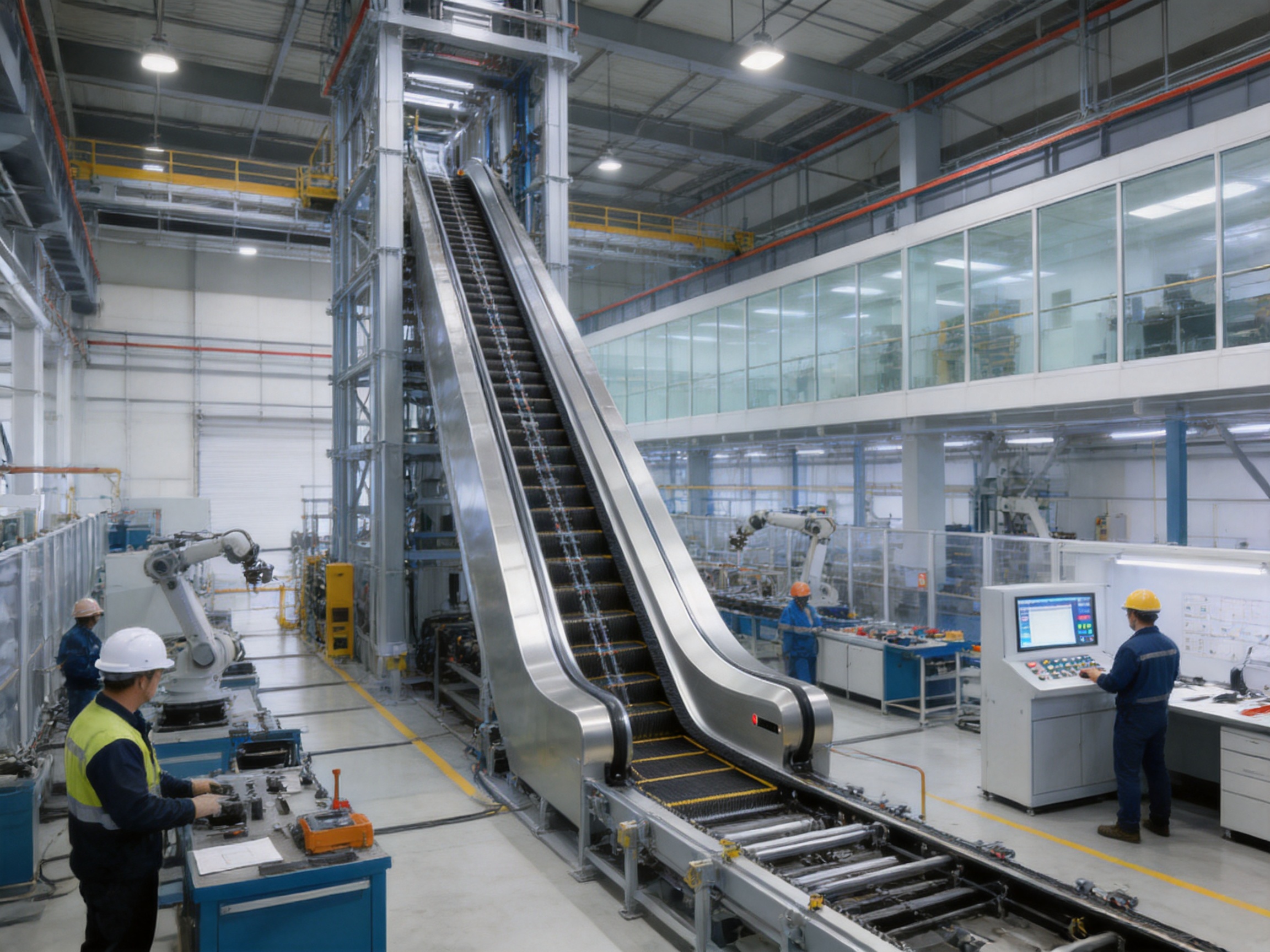
The presence of an escalator test tower allows the manufacturer to evaluate large equipment under representative conditions. The stated test-tower installation has a 25,000-millimeter travelling height and a 51,847-millimeter horizontal span, providing a substantial platform for evaluating long-travel performance.
Testing may include checks of movement stability, drive operation, braking, handrail synchronization, step alignment, emergency stopping, control functions, noise, vibration, and maintenance access. The exact test program depends on applicable standards and project requirements. A dedicated test environment is particularly useful for identifying issues before equipment is delivered to a customer site.
Factory testing can reduce project risk by allowing engineers to verify the equipment as a complete system. It can also support commissioning teams by providing reference data for installation, adjustment, and final acceptance.
Installation and Project Integration
A heavy-duty public traffic escalator is a major construction and transportation component. Successful installation requires coordination among the escalator manufacturer, architect, structural engineer, electrical contractor, general contractor, facility operator, and local inspection authorities.
Before installation, the project team should confirm the following items:
• Finished floor levels and structural openings.
• Escalator support points and load-bearing capacity.
• Transportation and lifting routes to the installation location.
• Machine-room and maintenance access requirements.
• Electrical supply, grounding, and control connections.
• Drainage and weather protection for outdoor applications.
• Fire safety, emergency access, and evacuation routes.
• Interfaces with elevators, stairs, moving walks, and surrounding finishes.
• Applicable local, national, and international standards.
• Inspection, testing, and acceptance procedures.
Outdoor installations require additional attention. Protective materials, sealing, drainage, corrosion resistance, temperature variation, dust, rain, snow, and ultraviolet exposure may affect the selection of components and finishes. The project specification should identify the environmental conditions clearly so that the correct configuration can be produced.
Professional installation is essential because even a well-designed escalator can perform poorly if it is incorrectly aligned, inadequately supported, improperly wired, or insufficiently adjusted. Installation teams must follow approved procedures and complete all required inspections before passenger service begins.
Maintenance and Serviceability
Regular maintenance protects passengers, preserves equipment performance, and extends the useful life of the escalator. Maintenance activities may include cleaning, lubrication, inspection of steps and chains, checking roller condition, examining handrail movement, testing emergency stops, inspecting brakes, verifying safety switches, and reviewing electrical and control systems.
The external roller arrangement supports serviceability because a roller can be renewed independently. This feature may reduce the extent of disassembly required during certain repairs. The accessible emergency stop arrangement can also support inspection and response procedures along the escalator length.
Maintenance planning should be based on operating hours, passenger volume, environmental conditions, manufacturer recommendations, and local regulations. A subway escalator operating continuously in a dusty underground environment may require a different maintenance schedule from an airport escalator operating in a clean indoor terminal.
Operators should maintain accurate records of inspections, repairs, component replacements, safety tests, and unusual operating events. Digital monitoring and data collection can help identify trends such as increased vibration, abnormal stopping frequency, changing handrail performance, or rising motor temperature. Early detection can prevent minor issues from becoming major failures.
Spare parts planning is also important. Critical items such as rollers, chains, handrail components, safety switches, brake components, and control equipment should be managed according to expected service life and procurement lead time. Maintaining appropriate spare parts can reduce downtime during planned and unplanned repairs.
Competitive Advantages
The escalator offers several advantages compared with basic commercial escalators or equipment designed for lower-intensity environments.
Heavy-Duty Public Transportation Design
The product is specifically configured for public transportation applications. Its reinforced step chain, substantial drive power, large rollers, auxiliary brake, multiple emergency stop switches, and four horizontal steps address the requirements of crowded and frequently used facilities.
High-Lift Capability
The 25-meter travelling height demonstrated in the test-tower installation supports large vertical connections. This expands the product’s application range beyond ordinary low-rise commercial projects.
Maintainable Roller Structure
The external roller arrangement and independent roller renewal can simplify maintenance and potentially reduce repair downtime. This is an important advantage for transport operators that cannot afford prolonged equipment shutdowns.
Enhanced Passenger Protection
Handrail speed monitoring, step demarcation, emergency stop switches, auxiliary braking, and four horizontal steps create multiple layers of passenger protection. Safety is supported through both mechanical design and operational controls.
Flexible Architectural Integration
Customizable step finishes, handrail colors, and side panel materials allow the escalator to adapt to different architectural environments. The product can be specified for functional infrastructure while still meeting visual design expectations.
Integrated Manufacturing and Service
Design, research and development, manufacturing, installation, and after-sales service are integrated within the company’s business structure. This can simplify communication, improve accountability, and support coordinated project delivery.
Intelligent Production
Automated production lines, Industry 4.0 manufacturing, data management, Internet of Things technologies, and closed-loop quality control provide a modern production foundation. These capabilities support stable quality and more systematic process improvement.
Applications in Subway and Airport Projects
Subway stations often contain long vertical connections between street level, ticket halls, platforms, transfer corridors, and underground passageways. Escalators may need to operate continuously during peak periods and remain available during extended service hours. The heavy-duty design is suitable for these conditions because it emphasizes load capacity, durability, safety monitoring, and serviceability.
Airport terminals present different but equally challenging requirements. Passengers may carry suitcases, travel bags, or other heavy items. Passenger flow may change significantly between arrival waves, boarding periods, security processing, and terminal transfers. A wide, stable escalator with a controlled speed and clear step demarcation can support a more organized passenger experience.
In both environments, the escalator should be integrated into a broader passenger circulation plan. Designers should consider the location of elevators for passengers with reduced mobility, the position of stairs for emergency use, the direction of peak passenger flow, the placement of signs, and the availability of unobstructed landing areas.
The escalator should also be evaluated for accessibility and inclusivity. While escalators are efficient for many passengers, they do not replace elevators or other accessible transportation systems. A complete public facility should provide suitable alternatives and clear guidance for passengers with disabilities, young children, large luggage, or other special requirements.
Recommended Selection Process
Organizations considering a heavy-duty public traffic escalator should begin with a complete project assessment rather than selecting equipment from a general catalog. The assessment should include passenger forecasts, building geometry, operating hours, environmental exposure, maintenance resources, energy objectives, and applicable standards.
The following sequence can help structure the selection process:
First, define the passenger transportation objective. Determine the expected peak flow, direction of travel, daily operating hours, and seasonal changes in demand.
Second, confirm the building geometry. Measure the travelling height, horizontal span, available width, structural openings, landing areas, and machine-room requirements.
Third, select the appropriate inclination and speed. The 30-degree test-tower configuration demonstrates one public transportation arrangement, while other project conditions may require a different configuration. The final selection must comply with the relevant standards.
Fourth, review safety requirements. Confirm emergency stop locations, handrail monitoring, brake systems, step demarcation, safety switches, signage, lighting, and building emergency integration.
Fifth, evaluate the environment. Outdoor and semi-outdoor installations require additional review of weather, drainage, corrosion, temperature, dust, and protective finishes.
Sixth, assess lifecycle costs. Include energy use, preventive maintenance, spare parts, service response, expected downtime, and component replacement.
Finally, confirm the manufacturer’s engineering, testing, installation, and after-sales capabilities. A technically capable supplier should be able to provide project drawings, technical support, installation guidance, commissioning assistance, maintenance recommendations, and long-term service coordination.
Frequently Asked Questions
What type of facility is this escalator intended for?
It is intended primarily for high-traffic public facilities such as subway stations, airports, railway terminals, shopping centers, exhibition halls, stadiums, public buildings, and pedestrian transportation links.
What is the rated speed of the test-tower configuration?
The stated rated speed is 0.65 meters per second. The final operating speed should be confirmed according to the project design, passenger flow requirements, local regulations, and selected configuration.
What is the step width?
The test-tower configuration uses a 1,000-millimeter step width. This provides a practical passenger area for public transportation applications and allows the escalator to accommodate passengers carrying personal belongings or luggage.
What travelling height has been demonstrated?
The escalator installed in the test tower has a travelling height of 25,000 millimeters. Actual project height depends on the building layout and the approved engineering design.
Does the product use a 30-degree or 35-degree inclination?
The supplied technical specification identifies a 30-degree inclination for the public transportation test-tower installation. The product information also describes a 35-degree space-saving escalator concept for compact spaces. The correct angle must be selected and confirmed for each project according to passenger use, available space, and applicable standards.
How does the external roller arrangement help maintenance?
The roller is positioned outside the step chain, and the main and secondary rollers have a stated diameter of 100 millimeters. The arrangement is intended to reduce compressed load on the main wheel and allows the roller to be renewed independently, which may shorten repair time.
What emergency protection features are included?
The system includes emergency stop switches at the upper and lower entry and exit areas, as well as additional switches at approximately five-meter intervals along the outer cover plate. It also includes an auxiliary brake, handrail speed monitoring, step demarcation, and other safety-related components.
Why are four horizontal steps used?
Four horizontal steps enlarge the transition or buffer distance at the travel area. This gives passengers more time to establish stable footing when entering or leaving the escalator.
Can the escalator be customized?
Customization options include step finishes, handrail colors, and side panel materials. Other project-specific features may be reviewed during engineering, provided that they comply with safety, structural, electrical, and regulatory requirements.
Is the escalator suitable for outdoor installation?
The product is identified as an outside-type escalator. Outdoor suitability depends on the selected configuration, local climate, drainage, corrosion protection, electrical protection, temperature range, and applicable project standards. These conditions should be specified before manufacturing.
What manufacturing strengths support the product?
The manufacturer integrates design, research and development, manufacturing, installation, and after-sales service. It uses automated production lines, Industry 4.0 intelligent manufacturing methods, data and Internet of Things technologies, and a closed-loop quality control system. It also reports ISO9001, ISO14001, and OHSMS18001 management standards.
How should operators maintain the escalator?
Operators should follow the manufacturer’s maintenance program and local regulations. Regular work may include inspections of steps, chains, rollers, handrails, brakes, safety switches, emergency stop devices, drive systems, electrical equipment, lubrication points, and control functions. Maintenance records should be retained and reviewed.
Conclusion
The heavy-duty public traffic escalator is engineered for demanding passenger transportation environments where safety, durability, capacity, and serviceability must work together. Its 1,000-millimeter step width, 0.65-meter-per-second rated speed, 25-meter test-tower travelling height, dual 37-kilowatt traction machines, 100-millimeter rollers, sprocket-driven handrail, auxiliary brake, distributed emergency stop switches, and four horizontal steps form a strong technical foundation for subway, airport, railway, and other public infrastructure projects.
Its competitive value comes from more than individual specifications. The reinforced step chain, external roller arrangement, improved transmission geometry, V-shaped handrail, high-capacity drive system, and multiple safety features address practical concerns faced by public facility operators. Independent roller renewal and systematic maintenance access can help reduce downtime, while energy-saving motors and standby operation can support lower lifecycle operating costs.
The manufacturer’s broader strengths further enhance the product. Integrated research and development, automated manufacturing, Industry 4.0 production methods, data-based quality management, advanced testing capabilities, international management standards, installation support, and after-sales service create a complete product delivery system. This is particularly important for major infrastructure projects, where successful results depend on engineering coordination throughout the entire product lifecycle.
When correctly selected, engineered, installed, and maintained, this type of escalator can provide a reliable passenger connection for facilities that must move people safely and efficiently every day. Its combination of heavy-duty mechanical construction, passenger-focused safety design, maintainable components, manufacturing capability, and project adaptability makes it a strong solution for modern public transportation environments.
References
1. Product technical specification for the heavy-duty public transportation escalator installed in the escalator test tower.
2. Product information concerning reinforced step chains, external rollers, auxiliary braking, emergency stop switches, handrail design, and four horizontal steps.
3. Manufacturer information concerning elevator, escalator, moving walk, and vertical transportation engineering capabilities.
4. ISO 9001, Quality Management Systems — Requirements.
5. ISO 14001, Environmental Management Systems — Requirements with Guidance for Use.
6. OHSMS18001 occupational health and safety management system information supplied for the manufacturer.
7. General engineering principles for escalator design, installation, inspection, passenger safety, and preventive maintenance.
Product: Heavy Duty Public Traffic Escalator for Subway & Airport Standards

Related Products
Related News
Built on safety, forging trust in vertical mobility.
lf you have any questions or need help, feel free to contact with our team.
 export@tenau.com.cn
 +86-18601458867
 +86-512-65059883
Elevator & Escalator
Factory Add
East of Xicheng Road, North of Lianyi Road, Nanxun Economic Development Zone, Nanxun District, Huzhou City, Zhejiang Province, P.R.China
Copyright © Tenau Elevator (China) Co., Ltd. All Rightd Reserved.
Custom High Quality Elevator Suppliers and World Brand Elevator Company